Governments, in the interest of developing national industries, would usually step in to subsidise expenditure into these riskier but more long-run rewarding sectors. Economist Ha-Joon Chang likes to bring up the fact that Alexander Hamilton back in 1791 was already thinking in terms of industrial policy through the setting up of a national bank to promote manufacturing.
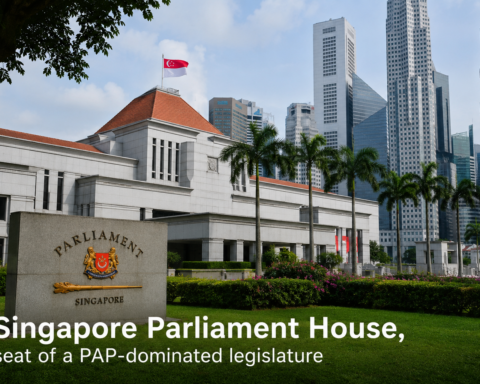
Singapore is routinely lauded as a model of disciplined governance, a city-state whose ostensible success is held up as evidence that rational administration, technocratic competence, and state planning can substitute for the chaotic dynamics of class struggle and social contestation. Its post-independence transformation is narrated as the triumph of foresight: a poor entrepôt remade into a global hub through industrial planning, export orientation, and bureaucratic coherence. Yet this narrative masks the underlying relations of domination that structure its growth. The Singaporean state has not merely guided accumulation; it has actively constituted the conditions of production, shaping the very relations between capital, labor, and land. Its reach into land ownership, credit allocation, labor supply, and enterprise does not simply coordinate markets as it mediates the distribution of surplus and reproduces existing hierarchies. The state functions as the principal agent of accumulation, its authority entwined with capital, ensuring that economic order is preserved while dissenting labor and marginalized classes are subordinated. From the outset, the ruling class rejected any autonomous sphere of market self-organization. Land was collectivized under public ownership, not to empower the working class, but to consolidate state control over property values and to extract rent from rising urbanization. Savings were compulsorily pooled into the Central Provident Fund, directing domestic surplus toward state-linked enterprises and infrastructural projects, while linking workers’ security to their compliance and integration into the system. Enterprise was organized around government-linked corporations, simultaneously serving as instruments of capital accumulation and vehicles of state authority. Foreign capital was welcomed conditionally: inflows were channeled toward sectors prioritized by the state, ensuring that control remained in the hands of the domestic ruling coalition. Labor policy treated workers not as autonomous producers but as adjustable inputs, disciplined through migration controls, wage segmentation, and regulatory flexibility. The result was rapid expansion, but expansion that substituted order and managerial efficiency for the autonomous development of productive forces.
The model that emerged is extensive rather than transformative. Growth was engineered by mobilizing inputs, labor, capital, and territory within a tightly managed framework rather than by cultivating the autonomous productivity of the working class or nurturing decentralized innovation. Firms learned not to compete on creative capacity or risk-bearing, but to align with state directives. Workers were subsumed into hierarchies that privileged employability and discipline over bargaining power, creativity, and upward mobility. The logic of accumulation was preserved through asset inflation: households were tethered to rising property prices, savings were mediated through compulsory instruments, and social security was individualized. The state’s authority functioned to guarantee surplus extraction while constraining alternatives to its administration. Visible crisis was minimized, unemployment remained low, and macroeconomic indicators appeared robust, but these outcomes obscured the exploitation and social precarity upon which they rested. This precarity is most evident in the labor and wage structure. The base of the workforce remains compressed, not due to scarcity of work, but because labor is treated as a malleable instrument of accumulation. The ready availability of foreign workers at lower wages weakens the incentive to restructure jobs or invest in productivity-enhancing technologies, while highly skilled imported labor displaces potential local mobility, reinforcing a hierarchy of remuneration that privileges capital over labor. The concentration of production and surplus in state-linked enterprises and multinational corporations limits the space for independent working-class initiative. The strategy is rational from the perspective of accumulation: aligning with the state guarantees continuity and access to resources; challenging the system risks marginalization. Households experience this system as managed dependence: security exists, but it is conditional, mediated by compliance with bureaucratic rules, and vulnerable to shifts in administrative discretion. Rising costs of living, particularly in housing and education, intensify inequality while reproducing intergenerational dependence on state-sanctioned assets rather than wages.
Political power and economic authority are inseparable in this configuration. The state maintains a monopoly not only over capital but over the regulation of discourse, the parameters of contestation, and the channels through which grievances can be expressed. Law does not constrain power; it structures and legitimizes it. Commercial actors enjoy predictability; laborers, citizens, and civil society actors navigate a landscape where dissent is expensive, ambiguous, and effectively contained. The asymmetry serves accumulation: the costs of capital remain low while the costs of resistance remain high. Efficiency and stability are produced not by consensus or class cooperation, but through coercive discipline and the structuring of incentives. Apparent social harmony is a product of containment, not resolution. Administrative competence replaces the unpredictable outcomes of social struggle with calibrated control, producing a polity depoliticized in form, even as social contradictions fester beneath the surface. The paradox of Singapore’s development is therefore rooted in class relations and the logic of accumulation. The same mechanisms that enabled rapid capital expansion now inhibit further transformation. A system organized around control and predictability struggles to foster the autonomous development of productive forces. Innovation is subordinated to state priorities, experimentation constrained by centralized incentives, and labor constrained by segmented markets and administrative oversight. The power of the state, concentrated and disciplined, increasingly functions defensively: it seeks not to enable growth but to preserve existing hierarchies. Administrative success masks structural immobility. Adjustments are incremental, entailing new sectors, new incentives, or refined bureaucratic procedures, rather than confronting the fundamental imbalance between labor, capital, and state authority. The system is strong in appearance but rigid in function.
The developmental impasse is amplified by demographic and social trends. Fertility rates at record lows, an aging population, and persistent reliance on imported labor intensify social stratification. Wealth is concentrated in real estate, financial assets, and state-linked enterprises, while wages stagnate at the base. The productive capacity of domestic labor is subordinated to the imperatives of accumulation; households are tethered to asset markets rather than empowered through collective social provision. Consumption, education, and mobility are constrained by the logic of managed dependence, which ensures that surplus extraction is efficient, predictable, and politically unthreatening. The state mediates both opportunity and limitation, creating a tightly controlled equilibrium in which the reproduction of capital and authority is inseparable. The resolution of this paradox requires a fundamental restructuring of both the political and economic order. Productivity-led growth cannot be imposed solely from above; it requires the autonomous development of productive forces, the unleashing of initiative among workers and entrepreneurs, and the creation of institutional mechanisms that enable critique and innovation without threatening stability. Political liberalization, transparency, and independent institutions are necessary to provide the feedback loops essential to efficiency that is not purely managerial but socially distributed. Immigration, industrial policy, and fiscal strategy must prioritize the development of domestic capability and equitable distribution of surplus rather than the perpetuation of short-term administrative control. Without such a redistribution of power, the state will continue to orchestrate growth while constraining the social relations that would make that growth resilient and inclusive.
In this sense, the Singaporean “miracle” is a historical anomaly: a city-state that achieved extraordinary accumulation through disciplined state intervention, yet did so at the expense of the working class’s autonomy and the organic development of productive forces. Its success is inseparable from the containment of class conflict, the orchestration of labor, and the centralization of surplus. The strength of the state, which is routinely celebrated, simultaneously constitutes the principal barrier to further transformation. Unless Singapore confronts the contradictions embedded in its developmental model — between capital accumulation and labor empowerment, between order and innovation, between macro-level efficiency and micro-level precarity — it risks consolidating an impressive but brittle structure: wealth and power concentrated, labor subordinated, and economic dynamism increasingly contingent on administrative discretion rather than social creativity. The challenge, therefore, is not merely one of policy, but of class and structural relations. The state must either maintain its role as arbiter of accumulation, perpetuating a system in which efficiency substitutes for equity, or it must cede a degree of authority to allow the productive forces of labor and enterprise to act with autonomy. Only by confronting the structural imperatives of accumulation, distribution, and control can Singapore hope to reconcile its past achievements with the demands of sustainable, socially inclusive development. The developmental paradox of the city-state is thus simultaneously a triumph of organized accumulation and a cautionary lesson in the limits of state-directed power: a society whose prosperity is real in aggregate, yet whose social and productive foundations are precarious, contingent, and ultimately constrained by the very apparatus that generated its ascent.
Productivity Deferred: The Logic of Accumulation
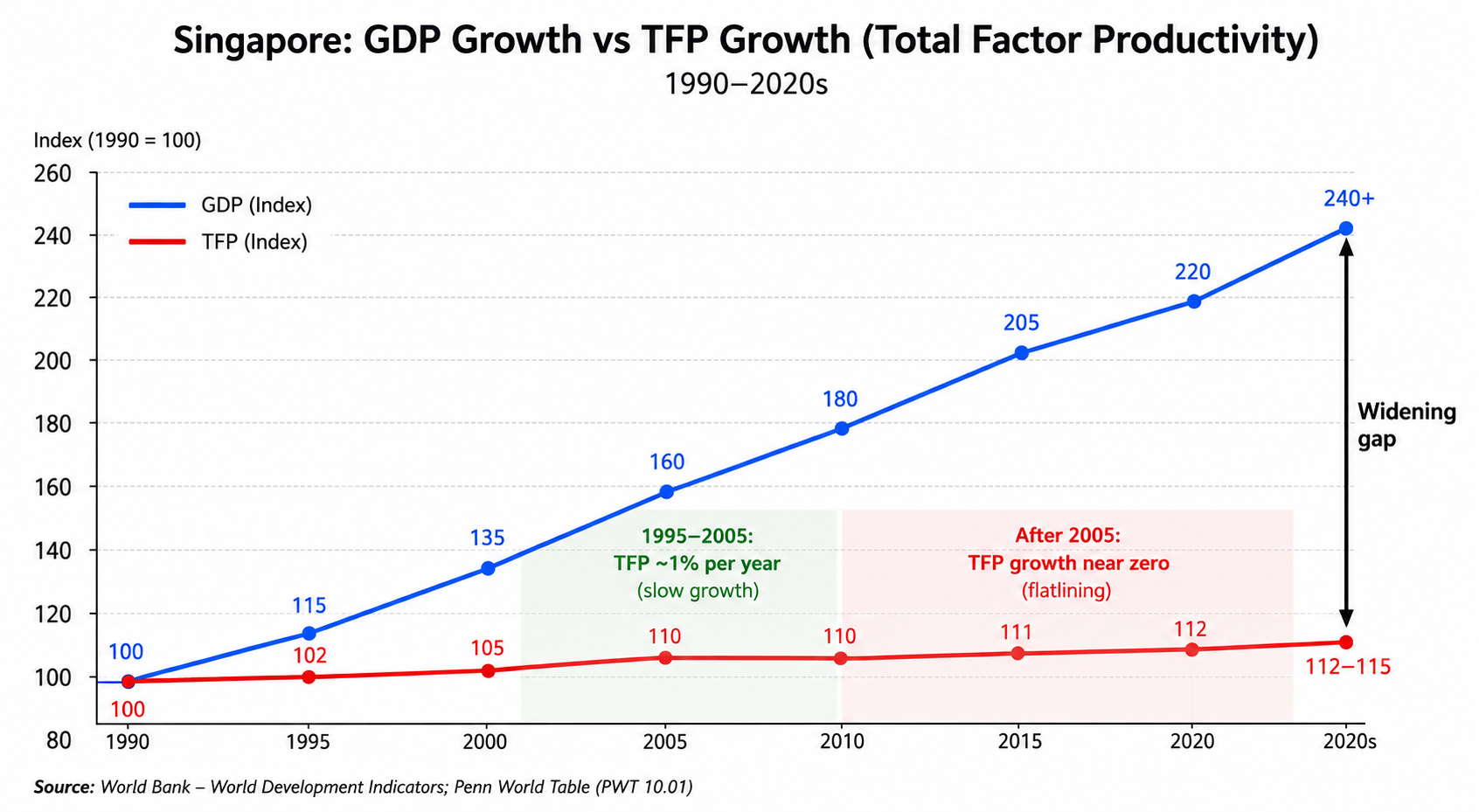
Singapore’s developmental paradox is not a question of capacity, discipline, or institutional competence, but rather the structural logic through which these instruments of power operate. Since independence, the People’s Action Party has overseen one of the most state-saturated growth regimes in global capitalism, a regime in which the state functions simultaneously as regulator, capitalist, and arbiter of surplus. By the early twenty-first century, the state directly or indirectly controlled close to nine-tenths of land, wielded decisive influence over the financial system through sovereign investment vehicles managing assets exceeding multiples of annual GDP, and maintained commanding stakes in key sectors through government-linked corporations that accounted for roughly a third of total market capitalization. These arrangements, while producing extraordinary macroeconomic outcomes as real GDP growth averaging over six percent annually for decades, mask a fundamental contradiction: growth has been achieved primarily through accumulation of inputs rather than the autonomous development of productive forces.
Total factor productivity, the measure of efficiency with which labor and capital are combined to generate output, has stagnated. During the early industrialisation phase, productivity gains were robust, reflecting the initial mobilization of labor and capital into previously underutilized channels. Yet from the mid-1990s onward, TFP growth has hovered near zero, punctuated only by episodic gains in capital-intensive frontier sectors. Between 1995 and 2005, productivity growth averaged barely one percent annually; in the decade that followed, it was lower still. Meanwhile, aggregate output growth relied increasingly on the expansion of labor and capital. The labor force grew by more than half between the late 1990s and the mid-2010s, driven overwhelmingly by non-resident workers, whose numbers at their peak exceeded one-third of total employment. This labor importation insulated firms from the necessity of internal productivity gains, substituting quantity for efficiency. Workers in the bottom quintile experienced stagnant real wages even as GDP per capita surged, with median wage growth lagging at less than half the rate of per capita GDP between the early 2000s and late 2010s — a structural decoupling that reveals the asymmetry between capital accumulation and labor remuneration. Capital accumulation followed a parallel logic. Gross fixed capital formation consistently exceeded a quarter of GDP, among the highest ratios in advanced economies. Yet these investments yielded diminishing returns in productivity terms. Infrastructure megaprojects, state-driven urban redevelopment, and capital-intensive manufacturing absorbed vast resources while contributing marginally to economy-wide efficiency. State-linked enterprises, insulated from market competition and granted preferential access to land and financing, reinforced this dynamic: operationally competent but politically anchored, these entities prioritize scale, stability, and risk avoidance over transformative innovation. The result is a bifurcated productive landscape: a small cadre of frontier firms exhibits high productivity, innovation, and patent output, while the majority of small and medium-sized enterprises remain constrained, producing less than half the output per worker compared to the largest firms. The productivity gap is widening rather than converging, producing structural dualism that undermines broad-based accumulation of skills, knowledge, and social capital.
The labor market is simultaneously disciplined and fragmented. Union density is low, collective bargaining tightly circumscribed, and wage determination shaped by state-mediated frameworks that emphasize global competitiveness over the equitable distribution of income. Labor’s share of national income has steadily declined, falling below OECD averages, while returns to capital, particularly in finance, real estate, and state-linked enterprises, have remained robust. Wealth concentration has intensified: the top decile commands an outsized portion of assets, while household debt has risen sharply as ordinary citizens borrow to maintain living standards amid escalating housing and consumption costs. Social reproduction is increasingly privatized: home ownership is high, but affordability is deteriorating, and public social expenditure remains modest relative to GDP. Fertility has declined to among the lowest globally, a demographic manifestation of economic precarity and structural pressure, revealing the constraints of a system that prioritizes accumulation over collective well-being. Education, hailed as a meritocratic equalizer, also reproduces the existing structure. High enrollment, strong standardized test results, and credential expansion mask a system oriented toward sustaining bureaucratic, managerial, and professional pathways rather than cultivating autonomous creative capacity. Graduates are funneled into roles that perpetuate the prevailing economic logic, while entrepreneurial experimentation is constrained by regulatory complexity, risk aversion, and the dominance of established state-linked and multinational actors. Surveys reveal low tolerance for failure and limited appetite for disruptive innovation, underscoring the structural limitations imposed by a system designed for controlled growth rather than autonomous productivity. Policy responses — skills upgrading, digitalization, and sectoral restructuring — fine-tune the machinery of accumulation without challenging its foundational logic: labor remains disciplined, small firms remain peripheral, and the concentration of surplus persists.
Political structures mirror and reinforce these dynamics. Electoral dominance by the PAP ensures that policy translation into outcomes occurs with minimal opposition, insulating the state from pressures that might otherwise redistribute power or incentivize structural reform. The state manages not only economic inputs but the boundaries of permissible discourse, the legal framework for dissent, and the institutions through which grievances might emerge. Law functions instrumentally: it structures expectations, legitimizes administrative discretion, and maintains order for capital while discouraging political contestation. Civil society operates within a zone of anticipatory compliance, where self-censorship substitutes for outright coercion. The asymmetry is functional: it secures capital accumulation while containing labor’s autonomy, ensuring that macroeconomic order reinforces political control. Efficiency is a product of power, not consensus, and the absence of open conflict reflects containment rather than resolution. The central paradox is therefore structural. The state that once propelled Singapore’s rapid ascent now presides over a system whose internal logic inhibits further transformation. Extensive growth driven by labor importation, capital deepening, and administrative coordination has become a substitute for intensive development rooted in productivity, innovation, and decentralized initiative. The pressures for structural reform are muted so long as macroeconomic aggregates remain favorable; yet beneath the surface, stagnation, inequality, and social strain accumulate. The economy is efficient in execution but brittle in adaptation, and the social relations of accumulation — labor subordinated, wealth concentrated, surplus extraction mediated by the state — pose constraints on sustainability.
The developmental impasse is thus both economic and political. True productivity growth requires the redistribution of power toward labor, smaller enterprises, and decentralized experimentation, which would simultaneously erode the state’s central coordinating role. Without this, accumulation will continue to rely on input expansion rather than the autonomous development of productive forces. Singapore’s “miracle” is not the product of impersonal markets or spontaneous innovation but the deliberate orchestration of capital, labor, and state authority. Its strength is also its limitation: a system capable of rapid accumulation that is simultaneously resistant to the emancipatory transformation of its productive forces. The statistics are clear: high investment, expanded labor inputs, and world-class infrastructure have not generated sustained productivity growth or broadly shared prosperity. Growth has become a matter of extension rather than intensification, of accumulation rather than innovation, and the paradox of Singapore’s political economy is laid bare.
Inequality and the Politics of Accumulation
 Singapore’s inequality is not an incidental by-product of development nor a transitory distortion awaiting technocratic correction; it is a structural outcome embedded within the political economy of accumulation. The People’s Action Party, acting as both coordinator and principal capitalist, has organized society around mechanisms that reproduce hierarchical access to resources, assets, and opportunity. Measured narrowly, income inequality appears moderate: official Gini coefficients report 0.435 before taxes and transfers, declining to 0.364 after state redistribution. Yet these statistics conceal the deeper architecture of social stratification, systematically excluding non-resident workers, who now constitute approximately 39 percent of the labor force. These workers, occupying construction sites, domestic service, low-value services, and temporary professional positions, exist as productive inputs rather than social actors. Their wages, living conditions, and precarity fall outside formal redistributive measures, ensuring that effective inequality is far higher than official figures suggest and situating Singapore among the most unequal high-income economies globally. This segmentation is not accidental; it is functional to the reproduction of capital. By distributing rights, welfare, and opportunity along lines of citizenship, the state maintains a disciplined, pliable labor force while suppressing the bargaining power of the majority of workers. Non-resident labor depresses wage inflation, provides disposable surplus labor for firms, and reinforces the separation between productive inputs and the social subjects entitled to redistribution. Over three decades, real wages for the bottom quintile grew at less than half the rate of labor productivity, while median wages lagged GDP per capita expansion — a structural decoupling that mirrors the classical dynamics of surplus extraction, in which growth is captured by capital rather than labor.
At the household level, these structural inequalities are compounded by the state’s asset-based management of social reproduction. Housing policy, once celebrated as an equalizer, now functions as a mechanism for intergenerational stratification. Over 90 percent of resident households own their flats, yet the Central Provident Fund — originally conceived as a social security instrument — ties retirement security to property accumulation, rendering households dependent on asset appreciation for wealth accumulation. Between the early 2000s and the early 2020s, public housing prices rose markedly faster than median wages, pushing price-to-income ratios into global-financial-hub territory. Early entrants to the property market, largely drawn from higher-income or politically aligned households, captured the gains of asset inflation, while younger and lower-income cohorts face higher leverage, longer mortgage commitments, and heightened exposure to market fluctuations. The state’s deployment of CPF-linked housing converts a social asset into a vector for wealth concentration, ensuring that accumulation remains mediated by administrative discretion rather than labor productivity.
Education, too, reproduces the hierarchy of accumulation. While enrollment and standardized achievement are high, the system functions as a sorting mechanism that converts pre-existing economic advantage into credentialed advantage. Private tuition has become effectively compulsory, with spending among top-decile families outpacing that of the lower half of households by multiples. Intergenerational mobility has declined; income elasticity has risen, signaling that social origin increasingly determines life outcomes. Education thus does not challenge the structural inequalities of accumulation but reinforces them, producing a labor force disciplined for bureaucratic and managerial roles rather than creative, autonomous engagement in production. The capitalist logic embedded in education reproduces consent while reproducing stratification: the system trains subjects to occupy positions within the existing economic hierarchy rather than to challenge it. This structural inequality is managed rather than mitigated. Social spending, while rising in absolute terms, remains modest relative to GDP, and redistribution is narrowly targeted to preserve social order rather than transform power relations. The state calibrates inequality to maintain labor compliance and political stability while sustaining capital accumulation. Housing supply, education pathways, labor migration permits, and conditional transfers function as instruments of social engineering, producing a compliant labor force and containing dissent within predictable channels. Redistribution occurs not as a recognition of entitlement but as a managerial adjustment, ensuring the reproduction of the social relations of production. By shaping access to opportunity along citizenship, income, and asset lines, the state stabilizes the social hierarchy while preserving the extraction of surplus by capital and state-linked enterprises.
Politically, this arrangement is reinforced by the PAP’s electoral hegemony. Parliamentary debate is channeled toward technical questions of calibration — eligibility criteria, transfer mechanisms, program design — rather than contesting the underlying distribution of surplus. Opposition voices, structurally marginalized and institutionally constrained, can highlight disparities but lack the leverage to alter the structural logic of accumulation. Inequality becomes normalized as a technical problem rather than a contestation of class power: the costs of capital accumulation are socially dispersed and politically depoliticized, while the gains remain concentrated. The economic consequences of this configuration are significant. Concentration of income and assets at the top suppresses domestic demand, as high earners have lower marginal propensities to consume, creating dependence on external demand and capital inflows to sustain growth. Wage suppression at the lower end of the labor market reduces incentives for firms to invest in skill development or productivity-enhancing technology, reinforcing the low-productivity equilibrium. Risk-averse behavior pervades households and firms alike, as insecurity, leverage, and conditional welfare diminish the capacity and willingness to innovate. Social reproduction is increasingly privatized, with individuals internalizing the risks of housing, healthcare, and education rather than relying on collective provision, ensuring that labor bears the cost of systemic accumulation. Demographically, inequality manifests in declining fertility and heightened family precarity. Material insecurity, long working hours, high housing costs, and intense competition for educational and occupational success act as structural constraints on family formation. State incentives, while mitigating immediate costs, do not alter the fundamental pressures created by asset-based accumulation, labor segmentation, and intergenerational inequality. Singapore’s trajectory mirrors that of other late-industrializing, state-managed regimes, in which rapid industrialization initially tolerated inequality as a cost of transformation, only for inequality to become institutionalized and reproduced over successive generations. Unlike welfare-oriented industrial states that expanded redistribution as productivity matured, Singapore has retained a managerial logic: controlling outcomes rather than redistributing power, containing discontent rather than confronting structural contradictions.
The paradox of Singapore’s inequality is therefore systemic. It is inseparable from its developmental model and its productivity impasse. By suppressing labor bargaining power, segmenting social access, and tying welfare to asset inflation, the state preserves order while curtailing the capacities necessary for innovation and intensive growth. Inequality is not a peripheral problem; it is constitutive of the very logic of accumulation that sustains Singapore’s growth. As long as redistribution remains conditional, mobility circumscribed, and labor subordinated, the developmental model will continue to prioritize order and capital extraction over broad-based productivity and social emancipation. The state’s success lies in managing surplus and social relations simultaneously, but this success is also the root of its structural limitation: the very mechanisms that stabilize accumulation now constrain transformation, embedding precarity, stratification, and stagnation within the formal prosperity of the city-state.
The Legal-Political Nexus of Accumulation
 Singapore’s political economy is anchored not merely in administrative competence or industrial strategy, but in a legal–political apparatus that disciplines social and political life in the service of capital accumulation. From independence, the People’s Action Party understood that the extraction of surplus and the stabilization of capital required more than industrial planning; it required the creation of a legal architecture that subordinated political contestation to economic imperatives. Law in Singapore has never functioned as an autonomous arbiter; it is a mechanism for organizing the conditions of accumulation. Where commercial activity demands certainty, the law is liberal and protective; where social or political movements threaten the hierarchy of extraction, it is restrictive, punitive, and anticipatory. This duality — freedom for capital, constraint for labor and dissent — is central to the reproduction of both economic order and state authority, and it constitutes a structural element of the city-state’s developmental impasse. Commercial law exemplifies this selective liberalism. Courts are efficient, predictable, and insulated from corruption. Contracts are enforced, property rights protected, and regulatory frameworks stabilized. The World Bank consistently ranks Singapore among the top decile globally in rule of law and regulatory quality, a positioning that signals to global capital that surplus extraction can occur with minimal political disruption. Foreign direct investment stocks expanded from under US$100 billion in the mid-1990s to over US$2 trillion by the early 2020s, a disproportionate accumulation relative to population size, revealing the structural success of a legal regime engineered to prioritize capital security over social redistribution. The legal infrastructure operates as a guarantor of accumulation, producing a disciplined environment in which capital can be deployed efficiently, risk is minimized, and labor remains subordinated.
Political law, in contrast, functions to discipline opposition and enforce anticipatory conformity. Civil defamation suits, short electoral campaigns, redistricting, and mechanisms such as Group Representation Constituencies create an environment in which dissent is institutionally constrained. Opposition actors internalize these pressures; their behavior is moderated by the threat of financial ruin, legal sanction, or political exclusion. The introduction of POFMA in 2019 and FICA in 2021 extended this legal reach into digital and civic life, signaling that autonomous organization outside state-sanctioned channels carries systemic risk. These instruments are less about immediate coercion than about producing self-discipline: a population and a polity trained to anticipate constraints and internalize subordination. Political authority and economic power converge; the legal apparatus ensures that surplus extraction is insulated from contestation while dissent is contained within manageable bounds. The consequences of this nexus for the economy are profound. Firms and investors operate with minimal fear of regulatory discontinuity, but the same environment reinforces structural inequality and suppresses autonomous innovation. State-linked enterprises, Temasek Holdings’ portfolio firms, and large multinationals benefit from implicit guarantees, preferential access to land, capital, and regulatory approvals, while small- and medium-sized firms must navigate a labyrinthine compliance regime. Productivity gains are concentrated at the frontier; the broader labor market experiences stagnation. Real wage growth lags, labor’s share of national income declines, and reliance on migrant labor dampens incentives for automation and firm-level innovation. Anticipatory discipline, extended from political life to the economic sphere, produces an environment in which risk-taking is rationally avoided, experimentation curtailed, and hierarchy reinforced.
Labor itself is subordinated within this framework. The absence of independent trade unions, coupled with the corporatist integration of labor into the state apparatus, ensures industrial peace and limits wage bargaining. Low-wage sectors, heavily reliant on non-resident workers, remain trapped in precarity. The legal-political nexus, by shaping expectations, employment practices, and labor costs, reproduces the conditions of capitalist extraction: labor is disciplined, surplus flows to capital, and dissent is neutralized. This arrangement mirrors the structural logic observed in other state-led capitalist regimes: stability is achieved through control, not consensus; accumulation is safeguarded at the cost of systemic dynamism. The paradox of Singapore’s legal-political nexus is revealed in the context of globalization. As economic growth becomes increasingly dependent on innovation, knowledge, and decentralized decision-making, the qualities required for intensive productivity — risk-taking, experimentation, and autonomous initiative — clash with a legal framework optimized for control. Grants, innovation clusters, and sandboxes operate within centralized hierarchies, producing localized efficiency while leaving the wider economy’s productive capacity constrained. The state guarantees predictability for capital at the cost of pluralism, political contestation, and labor autonomy. Growth continues, but it is managed rather than emergent; productivity gains remain concentrated rather than diffused; inequality persists; and social mobility is curtailed.
Singapore’s legal-political nexus illustrates the reproduction of class relations: law is not a neutral arbiter but a tool through which the ruling party organizes surplus extraction, regulates labor discipline, and maintains social hierarchies. The convergence of economic freedom for capital and restriction for political life secures accumulation while containing the contradictions of capitalism — class conflict, labor unrest, and social disruption — within administratively manageable bounds. It is a legal architecture of control, designed to maximize the extraction of surplus while stabilizing a political regime capable of sustaining it. The developmental paradox, therefore, is structural. The very apparatus that ensured the rapid ascent of Singapore now constrains its capacity for intensive growth. Productivity cannot be generated independently of legal and political pluralism; innovation cannot flourish where dissent is costly and risk is centralized. The law, far from resolving contradictions between capital and labor, ensures their containment: growth is extended, inequality reproduced, and order preserved, even as the economy’s capacity to renew itself erodes. Singapore’s success is, in this reading, not an expression of harmonious governance but of disciplined accumulation: a regime in which legal-political authority mediates surplus, governs labor, and constrains the social forces necessary for long-term productivity-led transformation.
Housing, Land, and the Rentier Logic of Accumulation
In Singapore, land and housing are not residual social goods or neutral commodities; they are central instruments of capital accumulation, social discipline, and class reproduction. From the earliest years of independence, the People’s Action Party recognized that control over land — the absolute scarcity imposed by a city-state geography — would determine the distribution of wealth, the cost of labor, and the stability of the capitalist order. By the mid-1970s, through the Land Acquisition Act and systematic expropriations at below-market compensation, the state had consolidated ownership of over 90 percent of the territory. This monopoly transformed land into a source of rent extraction and political leverage: the state simultaneously functions as landlord, regulator, planner, and distributor of surplus, embedding households into a system in which access to shelter is inseparable from participation in asset markets mediated by political authority.
The Housing and Development Board became the primary interface through which this domination was materialized. By the 1980s and 1990s, public housing encompassed over 85 percent of resident households; by 2024, approximately 76 percent remained in state-mediated dwellings. These flats are leased for 99 years, ensuring that while citizens internalize asset appreciation, ultimate control remains with the state. Homeownership is thus less a vehicle for social empowerment than a mechanism through which labor is disciplined, consent manufactured, and surplus capitalized. The Central Provident Fund, with mandatory contributions rising to 37 percent of wages by the early 2000s, channels household savings directly into real estate. Retirement security is subordinated to asset inflation: households’ material well-being is tethered to the continued valorization of land rather than productive labor. In macroeconomic terms, this suppresses consumption — household expenditure remains 35–40 percent of GDP compared to over 55 percent in comparable economies — while sustaining elevated domestic savings and current-account surpluses exceeding 15–20 percent of GDP for nearly two decades. Housing is therefore both a vehicle of capital accumulation and a mechanism of social control.
The dynamics of asset inflation reproduce and amplify class divisions. Between 2009 and 2013, HDB resale prices rose over 80 percent; after 2020, they surged again, with resale flats increasing by more than 40 percent in just three years. Private housing prices more than doubled between 2004 and 2023. Median wage growth, particularly for the lower half of the income distribution, has lagged far behind, rendering the laboring classes increasingly dependent on credit and asset inflation for social mobility. Early cohorts captured gains through speculative appreciation, while younger households face escalating leverage, longer mortgage horizons, and greater exposure to policy uncertainty. Household debt-to-GDP ratios stabilized at 65–70 percent in the 2010s, moderated by international standards but concentrated in property and tightly linked to state-managed channels of accumulation. This arrangement is explicitly generational and hierarchical. Older homeowners, whose tenure coincided with the initial expansion of state-managed housing, benefited from wealth effects; younger cohorts confront barriers that reproduce precarity. The 99-year lease embeds structural uncertainty: as flats age, resale values decline, and retirement adequacy becomes contingent upon continued asset inflation or selective state interventions such as the Voluntary Early Redevelopment Scheme. The state does not guarantee universality; risk is externalized to households, reinforcing dependency on the property market.
Control over land supply further consolidates class power. Through the Government Land Sales program, the state dictates the rhythm and price of land release, extracting rents and transferring them into fiscal coffers. Higher land values reverberate through property and commercial sectors, privileging capital over labor. Gross operating surplus and property income account for over half of national income, while labor’s share remains around 37 percent, below advanced-economy norms. Housing inflation suppresses real wages, particularly for lower-income citizens, while employers rely on migrant labor to maintain profitability. The structural logic is clear: labor costs are contained, household indebtedness increases, and the incentive for firms to invest in productivity-enhancing technologies is diminished. Total factor productivity growth outside a narrow set of capital-intensive sectors has stagnated since the mid-2000s. The social consequences mirror these dynamics. Fertility has fallen from replacement levels in the 1970s to 0.97 in 2023, among the lowest globally, reflecting not just cultural change but the material pressures of a property-dependent economy. Housing costs, delayed household formation, and financial precarity serve as instruments of social discipline. State subsidies and grants mitigate symptoms but reproduce the underlying structure: households remain subordinated to a system in which wealth accumulation is inseparable from compliance with state-defined asset pathways. Housing also functions politically: by embedding the working and middle classes in property-based wealth, the PAP secures alignment between household interests and regime stability. Sharp corrections in property markets would threaten both accumulation and consent, reinforcing the state’s imperative to maintain asset inflation.
The structural inequalities generated are stark. Non-permanent residents, roughly 39 percent of the workforce, are excluded from ownership, bear high rental costs, and subsidize the accumulation of wealth for citizens without benefiting from it themselves. Within the citizenry, disparities are magnified by flat location, timing of purchase, and type, creating intergenerational stratification. Housing operates as a conduit for rentier capitalism within a developmental state: land rents are captured, circulated through controlled channels, and valorized through asset appreciation to sustain consent and social order. In its early phase, this model enabled rapid urbanization and social stability; in its mature phase, it produced rigidity, diverting capital toward property rather than productive enterprise, privileging asset defense over risk-taking, and orienting policy toward valuation maintenance rather than innovation.
This is the heart of Singapore’s developmental paradox: the instruments that enabled state-led expansion — land monopoly, property-based wealth accumulation, and household indebtedness — now constrain the transition to intensive, productivity-driven growth. By substituting asset inflation for wage growth and channeling savings into property, the state suppresses domestic consumption, entrenching inequality and intergenerational tension. By linking social stability to rising prices, it narrows policy space and intensifies systemic vulnerability. Headline economic indicators — GDP per capita, fiscal surpluses, investment inflows — mask the underlying rigidity of an economy increasingly reliant on managed scarcity rather than creative abundance. Land and housing are vectors of surplus extraction: they reproduce class hierarchies, discipline labor, and stabilize accumulation at the expense of broad-based productivity. Unless the economy can redirect capital and social energy toward innovation, skill diffusion, and competitive enterprise, Singapore’s reliance on housing as the central store of value will perpetuate its productivity impasse and crystallize structural inequality.
The Imperative of Intensive Growth
 Singapore’s developmental trajectory reveals a classical paradox of state-led capitalism: the very instruments that drove accumulation now impose structural limits on the deepening of productive forces. The extensive growth model that transformed a postcolonial entrepôt into a high-income economy was not accidental; it was a deliberate strategy of capital valorization orchestrated by the state. Through the mobilization of foreign capital, large-scale importation of labor, suppression of domestic consumption in favor of forced savings, and centralized control over land, infrastructure, and industrial investment, the People’s Action Party constructed a framework in which surplus extraction and accumulation could proceed with minimal friction. Between 1965 and 1990, real GDP growth averaged over 8 percent annually, manufacturing’s share of GDP nearly doubled, and unemployment fell from double digits to below 3 percent. Yet these achievements were fundamentally extensive: they depended on the expansion of labor, capital, and territorial control rather than on a qualitative transformation of labor productivity. The accumulation process subordinated social reproduction to the imperatives of capital, embedding households within mechanisms — compulsory savings, housing dependence, and wage discipline — that externalized risk and concentrated wealth. By the early 2000s, Singapore had entered the ranks of advanced economies, with GDP per capita surpassing US$30,000 in purchasing-power parity terms and climbing toward US$90,000 by the 2020s. Yet the underlying logic of growth remained unchanged: output expanded through factor accumulation rather than the intensification of labor, technological upgrading, or redistribution of knowledge. Total factor productivity, which had averaged 2 percent annually during the industrialization phase, stagnated after 2005, dipping into negative territory outside select capital-intensive sectors. The social relations of production — wage labor, asset dependence, and the concentration of capital — became the principal constraint on the development of productive forces. The economy grew larger but not deeper; surplus extraction continued, but the capacity to transform labor into higher-value output plateaued.
The labor regime is central to this impasse. Singapore’s workforce expanded primarily through imported labor, not domestic demographic renewal. By 2023, non-residents constituted approximately 39 percent of the labor force, up from roughly 25 percent in the late 1990s. Migrant labor became concentrated in construction, cleaning, food services, logistics, and eldercare, while wages for resident workers at the lower end stagnated. Between 2000 and 2015, median real wage growth for the bottom decile averaged less than 1 percent annually, even as GDP growth remained robust. The availability of cheap, flexible labor altered firm behavior: the imperative to invest in productivity-enhancing technologies, redesign jobs, or restructure workflows was suppressed. Why invest in innovation when labor costs could be contained administratively, extracted from a segmented workforce? The extensive accumulation of labor and the superexploitation of non-residents reproduced a dual labor market, subordinating the local working class to capital while maintaining profitability for firms and rents for the state. High-skill migration, often presented as a corrective, reproduced the same structural hierarchy. Professionals and executives filled immediate skill gaps, but they intensified competition for scarce urban resources — housing, education, and social infrastructure — reinforcing the commodification of access to opportunity. Private residential property prices rose by more than 60 percent between 2010 and 2023, while median wages lagged, concentrating surplus extraction in real estate and limiting the diffusion of capabilities across the resident workforce. Industrial policy, from electronics to biomedical sciences, served primarily to channel state investment toward strategic nodes of capital accumulation. Research and development spending reached 2.2 percent of GDP by the late 2010s, but its benefits were captured by multinational corporations and state-linked firms, while small and medium enterprises employing the majority of residents remained confined to low-margin, low-productivity niches. Innovation was permitted only within state-sanctioned boundaries; risk-taking that challenged entrenched capital or the administrative order was constrained, suppressing systemic dynamism.
Fiscal policy reinforced these structures. Persistent budget and current-account surpluses, often exceeding 15 percent of GDP, reflected not only prudence but a deliberate strategy of deferring domestic consumption in favor of state-managed accumulation. Government consumption hovered at 15 percent of GDP, while private consumption fell from nearly 50 percent in 2001 to around 36 percent by 2024. Households bore a disproportionate share of risk through compulsory savings, exposure to asset markets, and the privatization of social reproduction — conditions that curtailed mobility and experimentation at the very processes that drive intensive growth. Education, long celebrated as meritocratic, functions as a sorting mechanism that reproduces class hierarchies. Approximately 70 percent of students rely on private tuition, with expenditures concentrated in higher-income households, entrenching intergenerational inequality. Credential inflation and graduate underemployment reveal a system unable to channel skills into productive, remunerative labor. Without structural change, education merely certifies compliance with an economy that valorizes capital over labor. Fertility fell from 1.60 in 2000 to 0.97 by 2023, and population growth has been sustained almost entirely through migration, reproducing the logic of extensive accumulation. An aging resident workforce, shrinking in size and growing in dependency, heightens the economy’s structural reliance on foreign labor precisely when global conditions are less permissive. Geopolitical constraints, technological fragmentation, and rising protectionism limit the channels through which Singapore historically expanded capital. Intensive growth is no longer optional; it is a structural necessity to resolve the contradictions of accumulation. Productivity-led development would require forcing firms to internalize labor costs, challenging the reliance on superexploited migrant labor, and compelling the diffusion of skills and capabilities across the resident working class. Aligning high-skill immigration with capability transfer rather than immediate demand would require training mandates and diffusion mechanisms that threaten entrenched private and state-linked interests. Redirecting fiscal surpluses toward social reproduction, human capital, and collective security would redistribute risk, incentivize mobility, and stimulate domestic demand — but would simultaneously diminish the disciplinary function of compulsory savings and asset dependence.
The resistance to these transformations is structural. The extensive model stabilizes surplus distribution, entrenches administrative discretion, and reproduces compliance through household indebtedness, asset dependence, and labor segmentation. Intensive growth disrupts these relations: power shifts from incumbents to innovators, from capital to labor, from administrative coordination to decentralized experimentation. For a state that equates order with success, this reallocation is both politically and economically risky. Yet failure to enact these changes will exacerbate inequality, deepen dual labor markets, and leave the economy vulnerable to shocks beyond the control of state planners. Singapore’s developmental paradox is thus exposed: the very apparatus that facilitated rapid accumulation — administrative coordination, labor segmentation, and asset-based social control — now constrains the qualitative advancement of productive forces. Without a decisive shift toward intensive, productivity-led growth that redistributes skills, risk, and capital, the city-state risks becoming an advanced economy in appearance only: a society in which administrative competence preserves aggregate outcomes while the social relations of production trap labor in subordinate positions and reproduce capital dominance across generations. The challenge is structural, not technical: whether the state can transcend the extensive logic of accumulation that served it so well, embrace the uncertainties of redistribution and innovation, and thereby renew the conditions for sustained and inclusive productivity growth.
Liberalization Towards Governance
 Singapore’s political economy cannot be understood apart from the class relations embedded in its state structures. The People’s Action Party’s developmental success rests on a dual logic: the integration of capital into the global economy and the enclosure of political and civic life domestically. From independence, the PAP constructed an apparatus of governance that subordinated social and political agency to the imperatives of capital accumulation. Administrative coherence, legal predictability, and policy continuity were prioritized over pluralism, dissent, or autonomous civic organization, producing a system optimized for the extraction and valorization of surplus. This architecture enabled the state to mobilize foreign investment, discipline labor, and coordinate industrial upgrading during phases of extensive growth. Yet these mechanisms, effective in consolidating accumulation, now constrain the qualitative transformation of the productive forces. The political economy of control that underwrote rapid growth increasingly stifles experimentation, feedback, and adaptive institutional innovation — all necessary for the transition from extensive to intensive accumulation. The PAP’s legitimacy has historically rested on performance rather than participation. Electoral dominance, never falling below two-thirds of parliamentary seats since 1968, reflects not the absence of class conflict but the subordination of oppositional voices through institutionalized asymmetries. Legal frameworks, informational monopolies, and administrative alignment collectively reproduce the hegemony of state capital and its allies. Civil defamation laws, historically deployed to bankrupt or disqualify opposition figures, alongside contemporary instruments such as the Protection from Online Falsehoods and Manipulation Act (POFMA) and the Foreign Interference (Countermeasures) Act (FICA), function less as neutral protections than as mechanisms to manage the political risk of subordinate classes asserting autonomy. Surveys indicate high levels of self-censorship among journalists, academics, and civic actors, demonstrating that political and ideological consent is partially manufactured through anticipatory discipline. The superstructure — including law, media, and institutional design — functions to reproduce the social relations of production by stabilizing the power of capital and the state while circumscribing the capacity of labor and civil society to challenge prevailing hierarchies.
This governance model has material consequences for accumulation and productivity. Singapore ranks among the world’s most efficient jurisdictions for contract enforcement and regulatory compliance, facilitating capital valorization. Yet these same legal instruments constrain autonomous collective action and feedback. Innovation requires not merely technical skill but the ability of subordinate actors to contest routine practices, propose alternatives, and experiment outside existing hierarchies. In Singapore, however, the cost of deviation is high: entrepreneurs and workers alike operate within a tightly managed institutional field. Small and medium enterprises, employing roughly two-thirds of the workforce, rely on cost containment and labor flexibility rather than genuine technological upgrading. State-linked and government-linked firms occupy dominant positions, benefiting from privileged access to finance, policy alignment, and regulatory protection, which channels surplus toward aligned capital rather than diffusing productivity gains across the working population. Risk-taking is subordinated to compliance; innovation is tolerated only within limits sanctioned by the state-capital complex.
Labor is integrated into this regime of control. Trade unions are absorbed into the National Trades Union Congress, which functions as an arm of the state rather than an independent representative of workers’ interests. Industrial peace is maintained, and wages are moderated, but at the cost of suppressing labor’s capacity to negotiate, innovate, or shape production processes. Productivity growth for resident workers lags headline figures, while low-cost migrant labor fills essential roles, reproducing dual labor markets and reinforcing the subordination of labor to capital. Economic policy, therefore, is not neutral; it reflects and reproduces the structural dominance of capital and its state apparatus over the working majority. This underscores the consequences of political enclosure for productivity. South Korea and Taiwan, which experienced authoritarian developmental phases, undertook liberalization as they matured economically. Democratization enabled broader labor representation, small-firm innovation, civic participation in industrial strategy, and institutional adaptation. Far from destabilizing accumulation, political opening facilitated a transition to intensive growth, revealing the limits of Singapore’s closed model.
Demographic pressures intensify these contradictions. Fertility remains among the lowest globally, dependency ratios are rising, and inequality — pre-transfer Gini above 0.43 — persists, compounded by asset-driven wealth concentration. Younger cohorts confront high housing costs, precarious employment, and constrained mobility. These pressures are treated by the state as technical problems to be managed, rather than as manifestations of class conflict or systemic contradictions. The managerialist approach preserves stability, but it curtails the social contestation and institutional pluralism that drive productivity-led growth. Singapore’s developmental paradox is rooted in the tension between control and creativity. The state’s administrative apparatus, which once enabled the disciplined accumulation of capital and labor, now constrains the development of productive forces. Productivity-led growth requires not merely capital deepening but institutions capable of absorbing dissent, redistributing voice, and enabling subordinate actors to participate in innovation and risk-taking. Without reducing the cost of political and social deviation, clarifying legal boundaries for civic engagement, and expanding autonomy for non-state actors, the economy remains structurally predisposed toward extensive, low-intensity growth.
The choice is not between stability and disorder but between the reproduction of existing social relations, which favors capital and administrative authority, and the transformation necessary to unlock intensive accumulation. A controlled opening, expanded civic feedback, and recalibrated state-society relations could stabilize legitimacy while unleashing new sources of productivity and innovation. Without such structural reform, Singapore risks becoming a society in which capital and state power remain concentrated, execution is efficient but creativity stifled, and the working majority remains subordinated — an advanced economy in appearance but constrained in its capacity for transformative development.
A New Social Compact
 Singapore’s current trajectory, while impressive in macroeconomic aggregates and international rankings, masks the underlying contradictions of a developmental model rooted in state-managed accumulation and class asymmetries. The city-state presents itself as a paragon of rational governance: fiscally disciplined, administratively efficient, politically stable, and economically competitive. GDP per capita exceeds US$80,000, sovereign wealth funds manage hundreds of billions, and foreign reserves remain historically high relative to population. Yet these aggregates obscure the structural imbalance embedded in the relations of production: the wealth, stability, and security of capital have been socialized, while the risks, precarity, and dependence of labor have been privatized.
The historical logic of Singapore’s growth model — extensive accumulation driven by imported labor, foreign capital, state-directed industrial policy, and asset inflation — has reached its limits. The state’s capture of land, the embedding of households in 99-year HDB leases, and the channeling of CPF savings into housing illustrate a regime in which social reproduction is subordinated to accumulation imperatives. Ordinary residents bear systemic risk: housing price volatility, segmented labor markets, high living costs, and rising debt. The state effectively socializes security for capital while transferring insecurity to households. Median wage growth has stagnated for the majority of resident workers, while property and financial assets, concentrated among older and higher-income cohorts, accrue disproportionate returns. This produces a dual economy: a minority benefits from capital valorization, while the majority experiences intensified precarity.
Demographics exacerbate these contradictions. Fertility rates have plummeted to near 1.0, dependency ratios rise, and the labor force increasingly relies on migrant labor, now constituting close to 40 percent of total employment. Imported labor suppresses incentives for productivity-enhancing job redesign, depresses wages in non-tradable sectors, and intensifies competition for urban resources, further entrenching structural inequalities. The state’s reliance on external labor to sustain output reproduces the extensive growth logic even as domestic capability building and deepening productivity are deferred. The result is accumulation without transformation: capital continues to expand, but the underlying relations of production remain rigid, hierarchical, and extraction-oriented.
A new social compact requires restructuring these relations. Economic expansion must shift from quantitative growth of inputs to qualitative deepening of productive forces and domestic capability. Immigration must be subordinated to skill transfer and broad-based workforce upgrading rather than short-term labor arbitrage. Industrial policy must cultivate decentralized experimentation and competitive innovation, rather than privileging state-linked “national champions.” Fiscal resources must support public investment in productivity-enhancing infrastructure, applied research, and human capital, rather than recycling rents into asset inflation that reinforces intergenerational inequality. Housing must be decoupled from wealth accumulation; social reproduction — including education, healthcare, and retirement — must be insulated from market cycles to reduce household dependence on speculative property and debt. Only by redistributing risk more equitably across society can the working majority be freed to participate meaningfully in production, innovation, and social development.
Political restructuring is inseparable from economic reform. Singapore’s governance model, with its legal-political enclosure, administrative dominance, and calibrated suppression of dissent, has historically disciplined labor and stabilized accumulation for capital. Yet these same mechanisms now constrain the institutional feedback, experimentation, and contestation essential for productivity-led development. Innovation, by its nature, emerges from the capacity of subordinate actors to challenge entrenched hierarchies, propose alternatives, and fail without catastrophic consequence. Under the current model, deviation is costly: legal risk, reputational sanctions, and exclusion from administrative networks enforce compliance. This reproduces class hierarchies, channels surplus to aligned capital, and restricts the development of productive forces among the broader population.
The paradox confronting the PAP is structural: the very competencies, reserves, and institutional authority that enabled accumulation now inhibit adaptation. Incremental reform is insufficient; the system will continue to reproduce itself, privileging order over creativity, administrative coherence over distributed capability, and asset-based wealth over wage-based or productivity-driven gains. Structural transformation requires political and economic decentralization: empowering workers, entrepreneurs, and civic actors to participate meaningfully in decision-making, innovation, and skill development. Reducing the cost of dissent, clarifying legal boundaries for participation, and strengthening autonomous institutions would expand productive capacity and reinforce legitimacy, rather than threatening stability. Without such a recalibration, Singapore risks becoming a high-income society of brittle foundations: capital-rich but innovation-poor, administratively efficient but socially constrained, economically impressive in aggregates but fragile in lived experience. Wealth and capability remain concentrated, households bear disproportionate risk, and productivity gains remain localized rather than systemic. The city-state’s celebrated “miracle” would thus assume a cautionary character: a model of accumulation perfected, but capability democratization and participatory transformation deferred.
A genuinely new social compact would redistribute both wealth and agency. It would enable the working majority to participate in productive innovation, reduce dependence on imported labor for accumulation, and anchor social reproduction in rights and public provision rather than market speculation. Growth would then be intensive — rooted in the expansion of skills, capabilities, and productive forces — rather than extensive, reliant on imported labor and asset inflation. The future of Singapore hinges on resolving the contradictions between capital and labor, accumulation and reproduction, control and creativity. Only by addressing these contradictions can prosperity be not merely sustained, but socialized, inclusive, and resilient.
 The writer is a graduate student from USM’s School of Social Science, interested in Comparative Politics, Historical Political Economy, and Chinese Politics. Prior to pursuing his undergraduate studies, he worked as a contributing researcher at political institutes and obtained a Bachelor Of Social Science (Hons) in Political Science and Philosophy from University Science Malaysia.