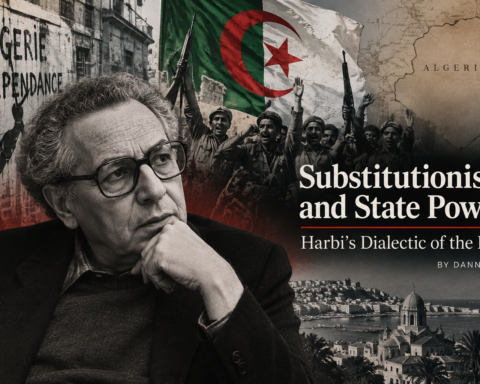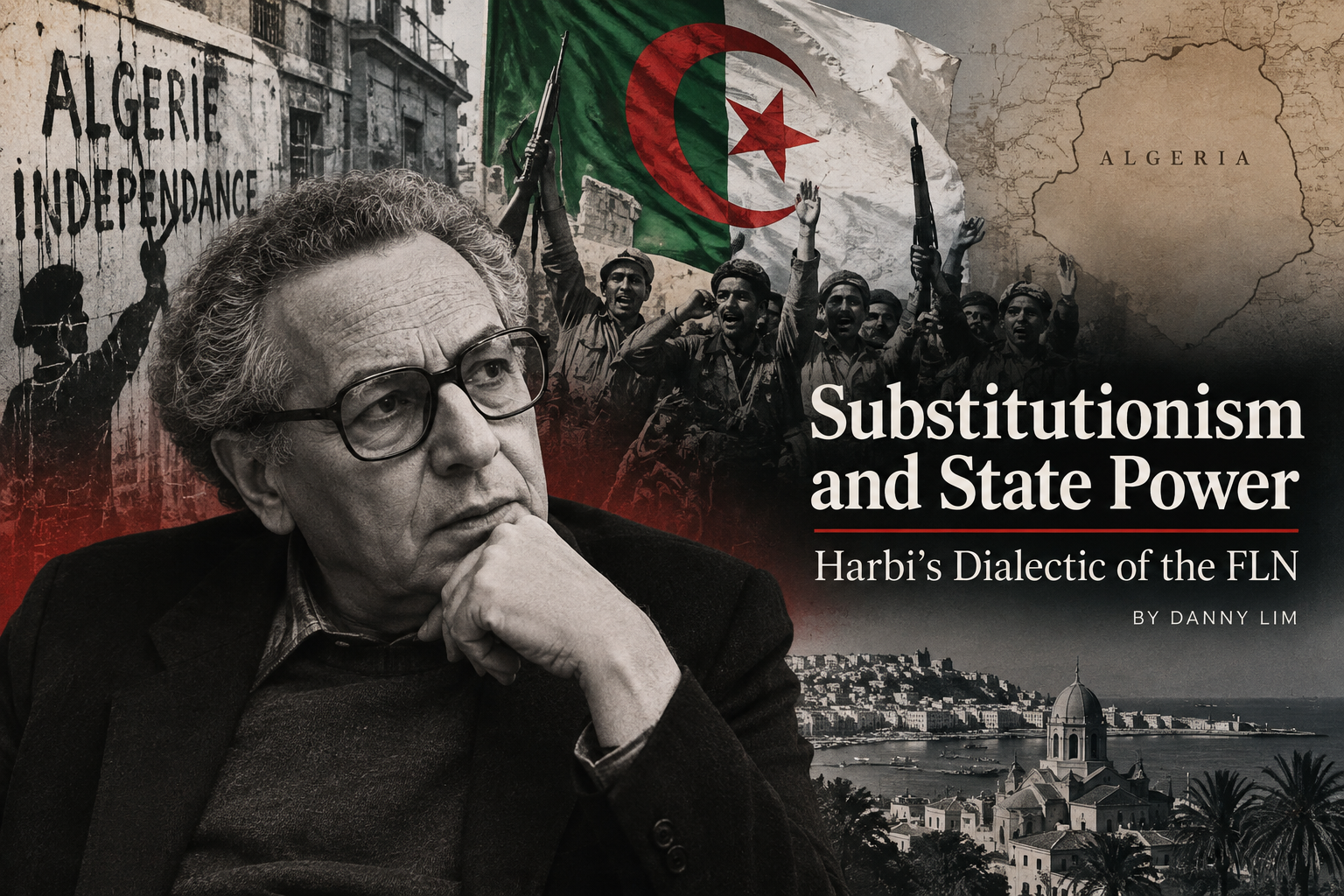
 By: Danny Lim
“Better to die on one’s feet than to live on one’s knees.”
— Jean Paul Sartre
It is with a sense of profound historical gravity, indeed with a heavy awareness of the closing of a definitive epoch in the history of revolutionary Marxism, that we mark the passing of Mohammed Harbi. He departed this life on the first day of January 2026, at the age of ninety-two, leaving behind a legacy that shatters the comfortable bourgeois narratives which so often encase the history of the Third World. To describe him merely as a historian of the Algerian Revolution is to commit a gross act of reductionism, to flatten a life of intense militant engagement into the passive observation of archives. Harbi was no mere scribe of events; he was a revolutionary actor, a conscious participant in the class struggle of Algeria, a militant cadre within the Front de libération nationale (FLN), and a critical, often dissenting figure in the turbulent formative years of the Algerian People’s Democratic Republic. Yet, to categorise him solely as a militant is also to miss the essence of his contribution. Harbi exemplified that rarest of phenomena in the twentieth century: the Marxist intellectual deeply embedded within a nationalist movement, seeking to direct the insurgent, often chaotic energies of the peasantry toward socialist ends, while simultaneously maintaining a ruthless, dialectical critique of the bureaucratic constraints imposed by the post-colonial state.
His life serves as a searing case study in the materialist contradictions that invariably confront revolutionary movements in the epoch of imperialist retreat: the collision, often violent, between liberation as lived by the oppressed masses and the structural imperatives of state formation under the constraints of global capitalism. Harbi’s death marks more than the passing of a man; it signals the silencing of one of the last voices capable of mediating between the visceral, immediate experience of the maquis, the militant, often peasant-led insurgency and the decisive, analytical clarity of historical materialism. His life compels us to reflect not merely on the specificities of Algeria’s anti-colonial struggle, but on the universal, tragic tendencies that plagued the revolutions of the twentieth century: the substitution of the party for the class, of the vanguard for the proletariat, and the ultimate transformation of emancipatory movements into instruments of bureaucratic domination. Harbi understood, with a clarity that was often painful to behold, that the seizure of political sovereignty does not in itself constitute the abolition of exploitation; indeed, the flag raised after the retreat of the colonizer may merely signal the entrenchment of a new ruling class, a native bourgeoisie draped in the mantle of socialism.
By the late 1940s, as the forces of decolonisation began to unsettle the seemingly monolithic hegemony of the old imperial order, a young Harbi engaged directly in political struggle through the Mouvement pour le Triomphe des Libertés Démocratiques (MTLD) under the leadership of Messali Hadj. The MTLD was, at that juncture, the primary vehicle for anti-colonial mobilisation in Algeria, a crucial political school where young militants learned the mechanics of organisation and the hard discipline of cadre formation. For Harbi, the necessity of armed struggle was not an abstract preference for violence but a conclusion dictated by the harsh material relations of domination: the French colonial state, a bastion of settler colonialism and capitalist exploitation, would yield power only to force, never to petitions or the moral appeals of the colonised. The state was an instrument of class oppression, and it could be smashed only by the organised counter-violence of the oppressed.
Yet, Harbi’s theoretical formation was no less decisive than his practical militancy; indeed, it was the steel that entered his soul. In the classrooms of the Lycée, he encountered Pierre Souyri, a former résistant against Nazi occupation and a leading member of the dissident Marxist group Socialisme ou Barbarie. It was through Souyri’s tutelage that Harbi acquired the analytic lens that would allow him to foresee the future distortions of the Algerian revolution with such prescience. Unlike the orthodox Trotskyists, who viewed the bureaucracy in the Soviet Union as a “degenerated workers’ state” as a parasitic caste feeding off a proletarian base—Souyri and his comrades struck at a deeper, more systemic root. They identified bureaucracy as a structural feature of class society itself, an emergent ruling stratum inherent to the hierarchical management of production and the alienation of labour. In this analysis, the Soviet Union, Maoist China, and, as Harbi would later observe with devastating accuracy, post-independence Algeria, were not “deformed” socialist states but bureaucratic capitalist formations. In these societies, the state owned the means of production, yes, but a managerial class, the bureaucracy monopolised surplus extraction and political power, exploiting the working class just as ruthlessly as any private capitalist.
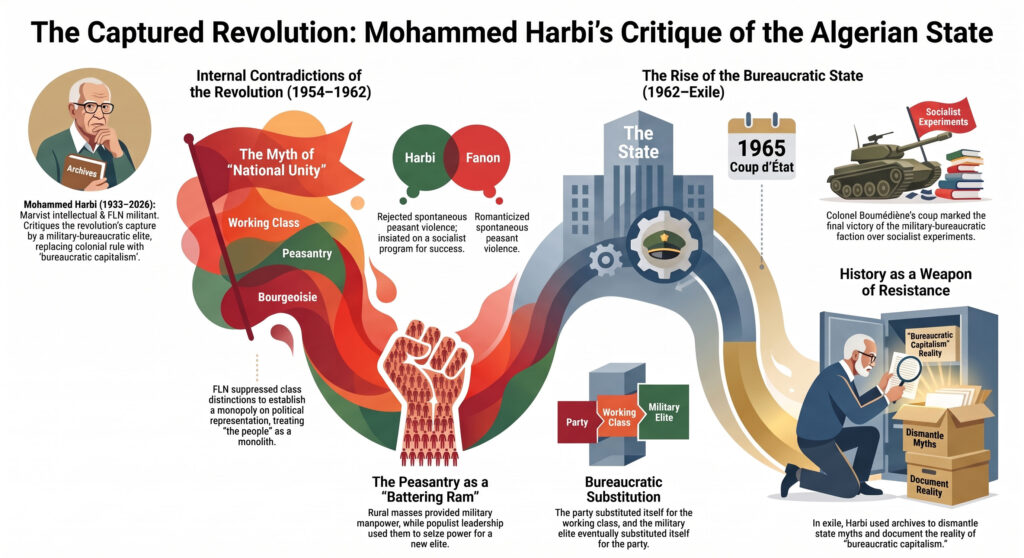
For Harbi, this framework was essential. It enabled a materialist understanding of nationalist movements that stripped away the romantic veneer of “national unity.” The enemy of the working class was not only the external colonialism but the potential reproduction of exploitation under a domestic bureaucracy, the “internal enemy” that rises from the ranks of the revolution itself. It was with this critical framework in mind, armed with a theory of bureaucratic substitution, that Harbi joined the FLN. The armed insurrection of 1 November 1954 was a historic rupture, a moment dictated by the utter exhaustion of petitioning colonial authorities. It was a proletarianised peasantry, dispossessed by capitalist land grabs and colonial theft, asserting itself under the leadership of a populist-nationalist vanguard. Yet, Harbi was acutely aware that the class composition of the revolution was uneven and fraught with danger. The rural poor formed the bulk of the fighters, the cannon fodder of the revolution, while the urban proletariat and the radical intelligentsia were often marginalised by the military logic of the struggle.
Harbi observed that the FLN’s populist leadership, while indispensable in mobilising the masses for the war against France, sought to sublimate class divisions in the rhetoric of national unity. This was, to be sure, a tactical necessity against a colonial power that practised divide and rule with lethal efficiency. However, Harbi recognised that this tactic carried the structural seeds of bureaucratic capture. The FLN was not a homogeneous revolutionary organ; it was a turbulent coalition of factions, a terrain of class struggle where the dominant populist current relied on ideological coercion and military force to impose its hegemony over other class interests. The “nation” became a fetish, an idol to suppress the specific demands of workers and peasants. For Harbi, the triumph of nationalism could never be conflated with the triumph of socialism; one was the condition for the other, but they were not identical.
This rigorous materialism led Harbi into a sharp and significant conflict with the prevailing romanticism of the time, most notably with the Martinican psychiatrist Frantz Fanon. Fanon, deeply impressed by the insurgent energy of the rural masses and their visceral rejection of colonial degradation, viewed peasant violence as a revolutionary agent capable of achieving social liberation in and of itself. There was a spontaneist streak in Fanon’s analysis, a belief that the act of liberation was self-validating. Harbi, conversely, insisted on the centrality of class consciousness and revolutionary leadership: mass participation was the necessary muscle of the revolution, but without the guiding skeleton of a working-class programme, it was useless. Without a conscious socialist programme steering the revolution, the peasantry, heroic as they were, could easily serve as the battering ram for the emergence of a new elite. They could overthrow the coloniser only to install a bureaucratic or bourgeois class in his place. Revolutionary violence, Harbi argued, is emancipatory only insofar as it is guided by conscious political strategy rooted in the material interests of the oppressed, not in the mystique of the “native soul.”
The post-independence period confirmed Harbi’s darkest warnings with the inexorable logic of a Greek tragedy. The FLN, having seized state power in 1962, immediately embarked on the consolidation of a bureaucratic apparatus that was, in many respects, a direct inheritance from the colonial administration. The methods of the French state, centralisation, hierarchy, the suppression of dissent were adopted by the new rulers. Harbi, a leading figure in the FLN’s left wing, attempted to orient the revolution toward genuine socialism, participating in the drafting of the Tripoli Programme, advocating for workers’ control of industry, and promoting the socialisation of the vast enterprises abandoned by fleeing European settlers. These were not utopian demands but essential measures to prevent the rise of a new exploiting class. However, these initiatives clashed violently with the structural imperatives of the emerging bureaucratic state, which sought to centralise all power in its own hands.
By 1965, the coup led by Colonel Houari Boumédiène marked the definitive triumph of the military-bureaucratic faction. The socialist experiments were halted, the voices of the left were silenced, and the state consolidated itself as the sole manager of the economy and the sole arbiter of truth. Harbi, isolated, imprisoned, and subjected to internal exile and house arrest, became a witness to the materialisation of the bureaucratic capitalist tendencies he had long analysed. The revolution, in effect, had devoured its own children, confirming the Marxist predictions regarding the substitution of the party for the class and the self-preserving, conservative logic of bureaucratic authority. His eventual escape to France was not merely a flight from physical danger but a retreat to a new trench of combat. In exile, Harbi turned to historical scholarship not as an academic retreat, but as a continuation of political struggle by other means. He understood that in the battle against the lies of the ruling class, the truth of the archives is a weapon. FLN, mirage et réalité (1980) and Aux origines du FLN (1975) deployed the analytical tools of Marxist critique to document the trajectory of the Algerian Revolution with forensic precision. He dissected the factional struggles, the purges, and the mechanisms through which the revolutionary vanguard transformed itself into a ruling class. These studies are not mere historiography; they are instruments of class analysis, excavating the material relations and power structures that define post-colonial Algeria. His meticulous documentation, exemplified in the massive edited collection Le FLN: Documents et histoire, 1954–1962 (2004), preserves the memory of the revolution as a struggle of classes, not merely as a nationalist myth designed to legitimise the rulers.
The Formation of a Revolutionary Consciousness
To understand the trajectory of Mohammed Harbi is not to follow the arc of an exceptional individual, nor to recount the picturesque adventures of a nationalist hero, but to trace the rigorous formation of a revolutionary consciousness within a determinate social totality. His life unfolded at the precise intersection where colonial domination met class differentiation within the colonised society, and where the contradictory emergence of nationalist politics under imperial capitalism was forced to confront the iron laws of historical materialism. Any serious account of Harbi’s development must therefore move resolutely beyond the phenomenology of experience beyond the flags, the slogans, the stirring moral dramas that serve as the currency of liberal historiography and descend into the material relations and institutional forms that structured both possibility and illusion in the twentieth-century anti-colonial struggle. Harbi’s political formation was not the product of an abstract ethical revolt, nor was it a sudden flash of enlightenment; it was the historical outcome of a specific position within a colonial mode of production, mediated by access to education, language, and political organisation.
Mohammed Harbi was born in June 1933 into a family situated within that narrow, precarious stratum of the colonised population which enjoyed relative material security and access to the French education system. This location was decisive, for it placed the young Harbi in the crosshairs of the colonial contradiction. Colonial Algeria was never the binary society of coloniser and colonised depicted in the simplistic propaganda of the Front de libération nationale (FLN) or its apologists; rather, it was a highly stratified formation in which a small indigenous intelligentsia was incorporated, albeit unequally, into the cultural apparatus of French rule. Harbi later described his childhood, without false modesty and with a sociologist’s precision, as “privileged.” But this privilege was neither stable nor sovereign. It was conditional, revocable, and structurally subordinate. It was a mediated inclusion designed to reproduce colonial administration rather than to dissolve it, creating a buffer class of native functionaries who were perpetually aware of the fragility of their status.
Access to the French lycées provided Harbi with immense cultural capital and linguistic fluency, but it also exposed the colonial contradiction in its most intimate, corrosive form. The lycée was the mechanism of ideological interpellation, the factory of the “évolué,” designed to produce subjects who were French in mind but subordinate in body. Yet ideology does not function seamlessly; the dialectic of colonialism ensures that the tools of domination contain the seeds of their own negation. The same education that sought to assimilate the colonised subject also laid bare the rank hypocrisy of colonial universalism. Harbi experienced, on a daily basis, the dissonance between the Republican equality celebrated in the textbooks and the racialised hierarchy of the colonial police state. This was not simply a moral affront; it was a structural revelation. He learned, early on, that domination operates not only through the coercion of the body but through the colonisation of consciousness, and that true liberation would require not merely national independence, a change of flags but a profound rupture with the social relations that sustained colonial power.
By the late 1940s, the global conjuncture had shifted irreversibly. The post-war crisis of European empires, the weakening of imperial legitimacy following the cataclysm of the Second World War, and the emergence of mass anti-colonial movements across Asia and Africa created the objective conditions for political radicalisation within Algeria. It was in this ferment that Harbi entered organised politics through the Mouvement pour le Triomphe des Libertés Démocratiques (MTLD), led by the veteran nationalist Messali Hadj. The MTLD represented, at that juncture, the most advanced form of nationalist mobilisation available to the Algerian masses: a mass party rooted in the urban workers, the sub-proletarians of the bidonvilles, and sections of the dispossessed peasantry, uncompromising on the question of sovereignty.
For Harbi, the necessity of armed struggle was not a romantic choice born of youthful impatience, nor was it a fixation on violence for its own sake; it was a material conclusion drawn from a scientific analysis of the nature of the colonial state. French rule in Algeria was not a benign administration awaiting reform; it was a settler-colonial project sustained by military force, racialised law, and the systematic expropriation of native land. It could not be dismantled through reformist negotiation or appeals to the conscience of the French bourgeoisie. The MTLD functioned as Harbi’s first school of political practice, a university of the streets. There he learned organisation as labour: the rigours of clandestine coordination, the discipline of the cadre, and the management of state repression. Yet, even as he threw himself into this work, the limits of nationalist politics were already visible to the critical eye. The MTLD, like other colonial nationalist movements, articulated the struggle primarily in terms of the nation rather than the class. This was a strategic necessity under the conditions of intense colonial repression, where the unity of the colonised was the prerequisite for survival, but it carried theoretical costs that would later become political liabilities. The suppression of the class question in the name of national unity sowed the seeds of the future betrayal.
The decisive transformation in Harbi’s intellectual development, the moment when his militancy acquired its distinctively Marxist character, occurred not in the smoke-filled rooms of the underground nationalist networks, but in the quiet, disciplined atmosphere of the classroom, under the influence of Pierre Souyri. Souyri, a former resistance fighter against Nazi occupation and a leading member of the dissident Marxist group Socialisme ou Barbarie, introduced Harbi to a Marxism that was radically opposed to both the Stalinist orthodoxy of the French Communist Party and the nationalist illusions of the MTLD. Socialisme ou Barbarie had emerged from a decisive rupture with orthodox Trotskyism, rejecting the notion that the bureaucracies of the Soviet Union and its satellites were merely parasitic deformations of a “degenerated workers’ state.”
Instead, Souyri and his comrades advanced a structural critique of devastating implication: bureaucracy was not an accident, nor a temporary corruption, but a new class formation arising from the hierarchical control over production and administration inherent in modern industrial society. The USSR and Maoist China were analysed not as transitions to socialism but as forms of bureaucratic capitalism, in which state ownership concealed the domination of a new ruling class of managers, technicians, and party officials who exploited the working class just as ruthlessly as any private capitalist. This theoretical intervention was decisive for Harbi. It displaced the moral narrative of betrayal as the idea that “bad men” had corrupted the revolution with an analysis of structural tendencies. Bureaucracy was no longer understood as the corruption of a revolutionary essence but as a predictable outcome of substituting state control for workers’ self-management.
For a young nationalist militant weaned on the myths of Messali Hadj, these ideas were profoundly destabilising. They undermined the comforting assumption that national liberation would naturally culminate in social emancipation. They suggested that the struggle against the French coloniser was only the first episode of a much longer drama, and that the most dangerous enemy might well be the “socialist” leaders who claimed to speak for the people. Yet, these ideas also provided the analytical tools to interrogate the internal dynamics of liberation movements themselves. Harbi later recalled that Souyri’s lectures “awakened” his interest in Marxism. But this awakening was not doctrinal; it was methodological. Marxism appeared not as a closed system of dogma but as a critical practice capable of analysing power wherever it reconstituted itself, whether in Paris, Moscow, or the Casbah of Algiers.
From this point onward, Harbi approached nationalism instrumentally rather than mystically. The nation was a terrain of struggle, not a transcendental subject of history. Independence was a necessary condition for emancipation, the breaking of the imperialist chains, but by no means a sufficient one. When Harbi joined the FLN and later became a member of its political leadership, serving within the structures of the Gouvernement Provisoire de la République Algérienne (GPRA), he did so with this critical awareness intact. He was a Marxist in a nationalist organisation, a position of immense tension but immense theoretical potential. The armed struggle that began on 1 November 1954 mobilised the peasantry on an unprecedented scale, displacing the urban proletariat as the central revolutionary force. This shift was materially grounded: colonial capitalism had fragmented and weakened the traditional working class, while the rural poor bore the brunt of dispossession and land theft. However, the political leadership that emerged from this mobilisation was populist rather than proletarian. The FLN, as it consolidated its control over the rural areas, constructed a discourse of national unity that actively suppressed class differentiation within Algerian society, presenting “the people” as a homogeneous revolutionary subject with unified interests. This was not merely rhetoric; it was the ideology of a rising bureaucratic class. Harbi recognised the danger immediately. The denial of class antagonism was not a neutral ideological move; it facilitated the concentration of power within the apparatus of the movement itself. By silencing the specific demands of workers and peasants in the name of unity, the leadership established its monopoly on political representation.
As the war progressed, the military-administrative structures of the FLN solidified, acquiring autonomy from the social forces that sustained them. What emerged in the mountains and the refugee camps was not a proto-socialist order but the embryonic form of a bureaucratic ruling class, legitimised by the rhetoric of sacrifice and insulated by the logic of secrecy and violence. The “substitution” warned of by the Marxists of Socialisme ou Barbarie was happening in real time: the party was substituting itself for the class, and the central committee was substituting itself for the party. Independence in 1962 did not interrupt this process; it consummated it. The colonial state apparatus was not dismantled but appropriated. The French garrisons left, but the prisons, the ministries, and the bureaucratic hierarchies remained, filled now by Algerian nationals. Nationalisation replaced private colonial ownership, but control over production and distribution passed not to workers or peasants, nor to the democratic organs of self-management, but to state managers, military officers, and party cadres. The FLN transformed itself from a liberation front into a ruling party, monopolising political power and suppressing autonomous organisations from below with a ferocity that echoed the methods of the departed colonial masters.
The logic identified by Socialisme ou Barbarie as the substitution of bureaucracy for class was reproduced with striking fidelity in the sands of Algeria. The new state was not a “dictatorship of the proletariat”; it was a dictatorship over the proletariat, exercised in the name of the proletariat. Harbi’s critique of the post-colonial state was therefore not retrospective disillusionment, nor the bitterness of a man excluded from power; it was theoretical consistency. He argued that the FLN had become the agent of a new form of domination: bureaucratic capitalism under nationalist symbolism. Socialist rhetoric functioned as legitimation, not transformation. The masses were mobilised as a source of authority during the struggle and demobilised, disciplined, and regimented once power was secured. Revolutionary consciousness was replaced by state ideology; participation was replaced by obedience.
Harbi dismantled the official mythology of the Algerian revolution with forensic precision. In his seminal works, he documented the purges, the factional violence, and the systematic elimination of alternative political currents, not as moral aberrations or regrettable excesses, but as expressions of a coherent bureaucratic logic. The state appropriated the memory of the struggle, converting martyrs into icons of passive reverence rather than models of active resistance, sanitising the radical past to serve the conservative present. History itself became an instrument of domination, a weapon to silence those who would point out the gap between the promise of the revolution and the reality of the state. Harbi understood, with rare clarity and courage, that the transition from colonial subject to citizen is not an evolutionary passage but a renewed class struggle. The post-colonial state does not resolve alienation; it reorganises it. The “national bourgeoisie” that Fanon warned against had mutated into a “state bourgeoisie,” a managerial class that owned the nation in the same way the colonisers had claimed to own it. Harbi’s life’s work stands as a Marxist indictment of this nationalist substitutionism. It is a reminder that emancipation cannot be delegated to states, parties, or armies, no matter how red their flags or how socialist their manifestos. It must be the conscious, self-organised act of the exploited themselves—or it will be expropriated in their name. Mohammed Harbi’s legacy is the unyielding insistence that the struggle for socialism is the struggle against the state forms that claim to embody it, a struggle that continues as long as domination persists.
The FLN: Instrument of Independence and Vessel of Contradictions
The armed insurrection of November 1954, which erupted across the Aurès mountains and the plains of Algeria, did not burst forth as a spontaneous effusion of national will, nor as the inevitable flowering of a long-suppressed cultural essence. To view it through the romantic lens of nationalist mythology is to misunderstand the very material foundations of the conflict. The insurrection was, in reality, the political expression of a profound structural impasse within colonial capitalism in Algeria. It was the point at which the contradictions of a settler-colonial mode of production founded on the expropriation of native land and the super-exploitation of native labour could no longer be contained by the mechanisms of reformist colonialism. When Mohammed Harbi committed himself to the Front de libération nationale (FLN), he did so with a materialist understanding of this rupture. He recognised the organisation not as a bearer of some mystical historical destiny, nor as a sacred vessel of the nation, but as a contingent political instrument as necessary, brutal, and internally contradictory as a battering ram. The FLN was capable of breaking the colonial state precisely because it concentrated coercive power, discipline, and ideological authority in a single apparatus. It was chosen not because it was pure, but because no other form then available to the colonised masses could prosecute a war against a settler-regime sustained by the military might of French imperialism and a legalised system of racialised law.
The insurrection of 1 November marked a decisive, irrevocable break with the reformist illusions of the urban elite and the parliamentary strategies inherited from the French political field. Colonial Algeria was not a society in which gradual reform could mediate antagonisms; it was a system predicated on the permanent exclusion of the colonised majority from political sovereignty and economic control. The settler colony, by its very nature, admits to no compromise that would jeopardise its hegemony. Therefore, armed struggle was not an ethical option, a matter of moral preference, but a structural necessity imposed by the intransigence of the ruling class. Harbi understood this clearly. The Algerian bourgeoisie, weak and complicit, had shown its inability to lead a genuine liberation movement. But Harbi also understood that the form of struggle chosen would decisively shape the form of power that followed. The hammer that smashes the prison door does not necessarily construct a free house; it may simply install a new jailer. The most significant transformation inaugurated by the war was not merely military, but deeply social. The centre of revolutionary gravity shifted from the urban working class, fragmented by colonial industrial policy, surveilled by the police, and structurally weakened, to the peasantry and rural poor. Harbi observed with analytical precision that “the direct involvement of peasants in the struggle marked a new stage” in the revolution. This was not simply a demographic fact to be celebrated in patriotic ballads; it was a class realignment with profound consequences for the post-colonial future. The village displaced the city as the primary site of mobilisation. The insurgent force was now composed largely of smallholders, landless labourers, and marginalised rural populations whose relationship to capital was mediated through dispossession, debt, and the feudal remnants of the colonial countryside, rather than through the wage labour of the modern factory.
This shift enabled the military success of the revolution. The peasantry provided the manpower, the logistical depth, and the territorial cover that allowed the FLN to survive the French military onslaught. They were the reservoir of the revolution. But this shift also imposed distinct political limits on the revolution’s trajectory. The peasantry, as Marx had long insisted in his analysis of the French peasantry, is not a class unified by a collective position in production, but a dispersed social category tied to land, locality, and custom. It is a sack of potatoes, lacking the organic cohesion of the proletariat. Its revolutionary capacity is enormous, but its political consciousness depends entirely on the nature of its leadership. In Algeria, that leadership took a populist-nationalist form. The dominant current within the FLN emerged not from the proletariat but from rural intermediaries, former soldiers, petty-bourgeois militants, and traditional notables radicalised by colonial violence. These leaders were not equipped by their class position to lead a socialist transformation. Their ideology was not class struggle, but national unity. They sought to mediate the conflict between the colonised masses and the colonial state, and in doing so, they positioned themselves as the new masters. Harbi saw immediately that the FLN was not a homogeneous revolutionary subject, a monolith of will. It was a coalition forged under conditions of total war, held together by the glue of discipline and the pressure of necessity rather than a shared class interest. Within this coalition, the populist leadership sought hegemony by actively suppressing internal differentiation. Class antagonisms within Algerian society—between workers and employers, between landless peasants and aspiring landowners, between intellectuals and military cadres—were systematically denied in favour of an abstract, undifferentiated concept of “the people.”
This was not an analytical error on the part of the leadership; it was a deliberate political strategy. By dissolving class distinctions into the singular category of the nation, the leadership positioned itself as the sole legitimate representative of the whole. To speak of class was, in their eyes, to divide the nation at a moment of peril. National unity thus functioned as an ideology of domination. During the war, it served a tactical purpose, shielding the movement from colonial divide-and-rule strategies and the co-option of minority groups. But as it hardened into dogma, it became an instrument for disciplining dissent and eliminating rival political currents. The FLN’s internal cohesion was maintained less through persuasion and democratic centralism than through coercion. Factional disputes were resolved not by the democratic deliberation of the rank and file but by purges, assassinations, and organisational exclusion. Harbi understood that this mode of internal governance was not incidental to the struggle; it prefigured the form of the post-colonial state. The methods of the war became the methods of the peace. The marginalisation of the urban proletariat and the radical intelligentsia was a direct consequence of this populist strategy. The working class, with its traditions of trade unionism, its insistence on class differentiation, and its programme of social rights, was increasingly treated as suspect—an import from Europe, a threat to unity, an obstacle to mobilisation. The very categories capable of articulating a socialist transition were dismissed as elitist or divisive. In their place, the leadership advanced a political mythology rooted in cultural identity, religion, and historical grievance. Islam and Arabism were elevated from social facts to organising principles of the nation, not because they expressed a coherent emancipatory programme capable of challenging capitalism, but because they offered an immediately intelligible language through which authority could be asserted over the rural masses. It was a politics of the lowest common denominator, designed to mobilise obedience rather than critical participation. Harbi was equally attentive to the FLN’s external political posture, recognising the chameleon-like nature of its discourse. Internationally, the movement presented itself as progressive, democratic, and socialist. It spoke the fluent language of Marxism to Western intellectuals, trade unionists, and Third World governments, framing the Algerian struggle as part of a global anti-imperialist front. This discourse was instrumental. It secured arms, diplomatic recognition, and moral legitimacy in the halls of the United Nations and the cafes of Paris. But it did not correspond to a settled internal programme. Domestically, the same leadership appealed to religious tradition and nationalist sentiment, mobilising obedience rather than critical participation. This dual discourse was not simply hypocrisy; it was the reflection of the class position of the FLN leadership itself: suspended between the traditional countryside and the modern state, between mass mobilisation and administrative control.
Their primary objective was not socialist transformation but the seizure and consolidation of state power. They were, in essence, a revolutionary bourgeoisie in waiting, utilising the rhetoric of socialism to disarm the working class while preparing to assume the managerial functions of the colonial state. The absence of a clearly articulated class programme allowed the movement to function as an empty vessel—capable of absorbing disparate ideological elements so long as they reinforced organisational unity. For Harbi, the decisive question was never whether independence would be achieved—the tide of history had made that inevitable—but what social relations independence would reproduce. By suppressing class struggle in the name of national unity, the FLN prepared the ground for the emergence of a new ruling stratum. The discipline forged in guerrilla warfare translated seamlessly into authoritarian governance. The centralised command structures developed under conditions of military necessity became permanent features of political rule. When independence arrived, the FLN did not dissolve itself into society; it installed itself above it. The socialist rhetoric that accompanied independence functioned as ideological residue rather than material programme. Nationalisation replaced colonial ownership, but control passed not to workers or peasants, nor to the democratic organs of self-management, but to state managers, military officers, and party cadres. The erasure of class distinctions during the war now justified the monopoly of power in peace. Opposition could be dismissed as anti-national; labour demands as divisive; democratic pluralism as a threat to unity. The state presented itself as the embodiment of the General Will, transcending and negating the particular interests of classes.
Harbi’s analysis exposed this continuity with devastating clarity. The contradictions of the FLN were not accidents of leadership, nor were they the failures of individual character or the corruption of otherwise pure ideals. They were the logical outcome of a nationalist movement that substituted the nation for the class and the party-state for popular self-emancipation. The post-colonial state that emerged spoke endlessly in the name of “the people,” while systematically depriving them of political agency. The revolution was preserved as myth and memory, a sacred cow to be worshipped, while its social content was hollowed out, stripped of the power to challenge the new hierarchy. In this sense, the FLN did not betray the revolution after independence; it completed a trajectory already inscribed within its wartime form. The seeds of the post-colonial state were present in the structures of the FLN from the very beginning. The authoritarianism, the suppression of dissent, the subordination of social demands to political unity—these were not deviations but the very mechanisms by which the FLN prosecuted the war. Once the external enemy was vanquished, these mechanisms turned inward, managing the internal contradictions of Algerian society. The chameleon did not change colour; it merely settled into the environment of independence, revealing its stable pattern. The Algerian state that emerged was not a deviation from the liberation struggle, nor a tragedy of lost innocence, but its bureaucratic resolution: a state that governed through the language of revolution while foreclosing revolutionary transformation itself. It was the triumph of the “national bourgeoisie,” evolving as predicted by the theorists of imperialism into a bureaucratic class, managing capitalism in the interests of order and accumulation, draped in the flag of the very revolution they had effectively captured.
The Spontaneist Debate
The dust of the Atlas Mountains seemed to settle not only on the rough woollen cloaks and the worn leather satchels of the militants but, more insidiously, on the political imagination of the men who gathered in the smoke-filled safe houses of Algiers, the temporary exile of Tunis, and the remote villages of the Kabylie. These were claustrophobic spaces saturated with the intense pressure of contradiction: a revolutionary resolve pressed hard against theoretical confusion; a disciplined, almost ascetic sacrifice coexisting with a startling degree of ideological improvisation. Coffee was poured in thick cups, maps were unfolded with urgent hands, communiqués were drafted by candlelight, but beneath the immediacy of armed struggle—the skirmishes, the ambushes, the relentless logistics of survival—lay a deeper, more decisive contest over the social content of the revolution itself. It was here, in this compressed terrain of war and theory, that Mohammed Harbi confronted the absolute limits of what was increasingly celebrated by a certain strand of radical intellectuals as revolutionary spontaneity. Harbi belonged to that generation of militants formed by Marxism not as a moral rhetoric or a poetic incantation, but as a rigorous method for the dissection of reality. He understood, with a depth that distinguished him from the romantic enthusiasts of the maquis, that revolution is a historically determined process rooted in the mode of production, in the specific relations of class, and in the objective organization of political power. For Harbi, the war of national liberation was not an end in itself, nor was it a mystical event where history stood still; it was a conjuncture, a specific moment in the chain of causality, whose outcome would be determined not by the sheer intensity of violence or the authenticity of suffering, but by the class character of the leadership that emerged from the crucible of struggle. Yet, around him in those tense, secretive meetings, another sensibility was gaining ascendancy as a dangerous, voluntarist exaltation of revolt, impatient with theoretical mediation, deeply suspicious of organisational discipline, and increasingly hostile to what it glibly dismissed as “orthodox” Marxism.
The sharpest and most influential expression of this spontaneist tendency was undoubtedly Frantz Fanon. Fanon’s intervention into the Algerian revolution was, in many respects, electrifying; its importance for the psychological decolonisation of the colonised mind cannot be denied. He grasped with extraordinary clarity the psychic devastation wrought by colonial domination and the absolute necessity of a violent rupture with the mother country. However, Fanon’s theoretical wager, most fully articulated in his seminal work The Wretched of the Earth, rested on a decisive displacement within the Marxist tradition. In a departure that bordered on the idealist, Fanon elevated the peasantry from a potentially revolutionary ally into the revolutionary subject sui generis. He treated the peasantry’s marginalisation from the colonial urban economy not as a structural condition requiring careful political mediation and education, but as an intrinsic guarantee of revolutionary consciousness. For Fanon, the peasantry’s distance from the factories, the trade unions, and the “corrupting” influence of the Europeanised city appeared as a form of ideological purity. Their exclusion was transfigured into virtue; their material deprivation was elevated into a sign of revolutionary authenticity. Violence, in turn, was endowed with a quasi-ontological role: not merely an instrument of struggle, a means to an end, but a generative force capable of producing new social relations by its own momentum. The act of revolt was treated as its own justification, the uprising as a self-clarifying process that would naturally yield a liberated society.
Harbi listened to these arguments with a growing sense of alarm that bordered on horror. What he heard was not a radicalisation of Marxism, but its effective abandonment. He recognised in Fanon’s celebration of the peasantry a dangerous theoretical slippage from materialist analysis to revolutionary romanticism as a substitution of sociological inquiry with moral projection. For Harbi, to ignore the specific relations of production that defined the peasantry was to court disaster. The Algerian fellah was heroic, certainly; he was capable of immense sacrifice and enduring endurance. But heroism is not a programme, and endurance is not a theory of power. This fundamental rift came to a head in one decisive exchange, a moment that encapsulates the tragedy of the post-colonial left. Following an FLN declaration that national and social liberation were identical and that the peasantry constituted the undisputed leading force of the revolution, Fanon and another comrade expressed unbridled joy, seeing in this proclamation the synthesis of their hopes. Harbi, however, broke the prevailing mood of jubilation with the cold water of materialist fact. He stated, with deliberate and brutal bluntness, that they were “living in a fantasy world, projecting political desires onto a rural society whose actual sociological structure they refused to analyze.” This was not a semantic disagreement over tactical priorities; it was a fundamental theoretical rupture. Harbi insisted on what Marxism demands as its starting point: that classes be analyzed not by their suffering alone, but by their objective position within the relations of production. The Algerian peasantry, Harbi reminded them, remained dispersed, bound to smallholding private property, and oriented toward the acquisition or defense of land. These were not moral failings, but material facts. To ignore them was to mistake participation for consciousness and numbers for direction.
Fanon’s response, a brief but unmistakable grimace of distaste, signalled the depth of the divide. In that fleeting, expressive movement was a broader rejection: a rejection of class analysis, of the primacy of the working class, and of the necessity of a party rooted in the relations of production. What Fanon perceived as dry, European dogma, Harbi recognised as the indispensable framework for preventing the revolution from collapsing into its opposite. Harbi knew that the spontaneist view was not merely analytically wrong; it was politically lethal because it refused to answer the decisive question: who holds power when the war ends? At the core of Harbi’s critique was the classic Marxist distinction between mass mobilisation and class power. The participation of the peasantry in the armed struggle was undeniable; without it, the war could not have been sustained for a week. The peasants were the army of the revolution. But participation does not determine outcome. Revolutions are not judged by who fights, but by who governs when the fighting stops. Without a conscious proletarian leadership to guide it, the peasantry—however militant, however brave—could only function as a military force, not as a ruling class. Its historical role, absent political mediation through a socialist party, was to clear the path for another class to seize the state.
This was the danger Harbi saw with chilling clarity, a clarity that allowed him to foresee the trajectory of post-independence Algeria years before the Evian Accords were signed. The FLN, increasingly treated as the embodiment of the nation itself, was evolving into an apparatus detached from both workers and peasants. Its leadership strata—officers, administrators, intellectuals—were coalescing into a proto-bureaucratic class. The language of socialism persisted, but it functioned ideologically, not programmatically. It was a language of legitimation, not transformation. Nationalisation without workers’ control; planning without proletarian power; unity without democracy: these were the hallmarks of a bourgeois-national revolution preparing to stabilise itself through the state apparatus. The spontaneist conception of revolution made this outcome not accidental, but structurally inevitable. By dismissing organisation as secondary and class leadership as dogmatic, it left the question of power unanswered. Violence shattered the colonial state, that much was true. But nothing was constructed to replace it except another state, centralised, authoritarian, and insulated from popular control. The FLN did not dissolve into the masses; it crystallised above them. What emerged was not socialism, but a form of Bonapartism without a proletariat: a regime claiming to speak in the name of the people while governing over them, using nationalist legitimacy to suppress class struggle and impose bureaucratic discipline from above.
In this grim denouement, the peasantry, once mythologized by Fanon as the motor of history, was returned to the countryside honoured in rhetoric, excluded in practice. The working class, never organised as an independent political force capable of asserting its dictatorship, was subordinated to the state. The revolution was completed only in its negative sense: colonial rule was abolished, but capitalist social relations persisted, now administered by a national elite. Harbi’s critique was never directed against the masses. He did not sneer at the peasantry from the vantage point of the city; he sought to arm them with the theory they needed to avoid becoming the tools of a new master. He directed his fire against illusion. He rejected the idea that suffering produces consciousness automatically, that violence substitutes for politics, or that the state can be seized without transforming its class character. Against the intoxication of immediacy, he posed the unromantic Marxist truth: that freedom is not an event but a process, and that without organisation, the process will be captured by those best positioned to command it. Seen from this perspective, the divergence between Harbi and Fanon marks not a personal disagreement but a historical fork in the road of anti-colonialism. Fanon articulated the catharsis of revolt; Harbi analyzed its aftermath. The former grasped the destructive necessity of violence against colonial domination; the latter understood the reproductive mechanisms of class power. The tragedy of Algeria, and indeed of much of the post-colonial world, is that the moment of rupture was mistaken for the moment of resolution. The wind still moves across the Atlas Mountains, whispering of the fallen, but revolutions do not live in the wind. They live or die in institutions, in class power, in the organisation of production and the control of the state.
Harbi’s warning endures because it names what spontaneity cannot overcome: that without a proletarian compass, the energy of the oppressed will always be harvested by a new ruling class. Anger is not a programme. Liberation is not automatic. And a revolution that refuses Marxism does not escape domination; it merely changes its administrators. The spontaneist debate, therefore, is not a relic of the 1950s; it is a perennial test of the socialist movement’s maturity. The choice remains what it was in the safe houses of Algiers: between the intoxicating path of least resistance, which leads to the bureaucratic swamps, and the hard, unglamorous road of class struggle, which is the only path to genuine human emancipation.
The Post-Colonial State Of Bureaucratic Deadlock
The dust of the Casbah seemed to cling to the very air within the room, a gritty, persistent reminder of the world outside: a world torn by the wail of sirens, the sharp crack of rifles, and the weeping of widows whose lamentations were becoming the soundtrack of a nation’s agonizing birth. Yet, within these claustrophobic quarters, steeped in the tension of a thousand whispered conspiracies, a battle of perhaps greater historical significance was being fought. It was the intellectual battle for the soul of the Algerian Revolution. While the mountains echoed with the primal fury of combat as a visceral, physical clash of bodies and bullets—a quieter, though no less ferocious, struggle was unfolding among the luminaries of the Front de libération nationale (FLN). It was a clash of visions, a theoretical duel that would determine the trajectory of the land long after the smoke of battle had cleared. It was here that Mohammed Harbi, a young intellectual with eyes that seemed to look through the romantic veneer of the moment to the cold structures beneath, found himself at loggerheads with the Martinican psychiatrist who had become the spiritual avatar of the Algerian struggle, Frantz Fanon. Fanon was a force of nature, a man who carried the weight of the colonised world in his brow and spoke with the incandescent heat of a prophet. His was a voice that did not merely analyse but thundered, seeking to awaken the dormant consciousness of a people beaten into submission by centuries of degradation. In the pages of The Wretched of the Earth, Fanon was crafting a testament to the revolutionary purity of the peasant, that stoic figure of the bled, the vast, unforgiving countryside. To Fanon, the peasant was the revolutionary class par excellence, uncorrupted by the seductive and debasing vices of the colonial urban economy. In the peasant’s silence, Fanon heard the roar of a new humanity; in the peasant’s lack of ties to the city, he saw an unblemished ideological purity, a tabula rasa upon which a truly free society could be inscribed. It was a vision of romantic grandeur, a paean to the raw, untamed violence of the oppressed as the necessary cleansing fire of history.
Harbi, however, sat amidst the swirling smoke of his cigarette, grounded in the unyielding bedrock of materialist analysis. He had drunk deep from the well of Marxist theory, mentored by those who understood that revolutions were not merely bursts of emotion, nor acts of moral will, but complex socio-economic upheavals governed by discernible laws—the laws of the mode of production and the relations of class. He looked at Fanon’s romanticisation of the peasantry not with disdain, but with a profound, aching sense of danger. He saw in it a mirage, a beautiful lie that could lead the revolution into a desert from which it might never emerge. The contrast between the two men was the contrast between the poet and the architect; Fanon saw the fluid, dynamic potential of the moment, the cathartic release of repressed energy, while Harbi saw the structural necessities that must underpin any lasting edifice. He knew that a revolution cannot be built on the foundation of suffering alone; it requires the concrete of class consciousness and the steel of political organisation. The tension between them crystallised around a specific, charged discussion that remained etched in Harbi’s memory like a scar. He recalled the scene with the vivid clarity of a recurring dream: Fanon and another comrade, their faces flushed with the unbridled ecstasy of the moment. They had just received news that the FLN leadership had issued a declaration proclaiming that national liberation and social liberation were one and the same, and furthermore, that the peasantry was the leading force of this revolution. To Fanon and his comrade, this was the moment of synthesis, the magical convergence of action and theory. Their joy was palpable, a radiant thing that seemed to illuminate the grim surroundings, but to Harbi, it felt like a fever dream. Harbi’s reaction was not one of celebration but of cold, piercing diagnosis. He looked at these men, whom he respected and admired, and felt the heavy burden of the truth he had to deliver. He did not soften his words; to do so would have been a betrayal of the future they were fighting to build. He told them, with a bluntness that cut through the euphoria of the room, that they “were living in a fantasy world and projecting their political desires and strategic considerations onto a rural world the sociological nature of which they were concealing from themselves.” It was a devastating accusation, implying that the architects of the revolution were building castles in the sky, ignoring the muddy, complex reality of the peasants they claimed to champion. They were seeing what they wanted to see—a vanguard of the proletariat in peasant garb—rather than what was actually there: a rural society fragmented, traditional, and often deeply attached to the private ownership of land, a society that was not naturally inclined toward the socialist utopia the urban intellectuals dreamed of.
Fanon’s response to this harsh materialist critique was telling. It was not an argument, nor a rebuttal of facts. It was a “meaningful grimace,” a subtle contortion of the face that spoke volumes. It was the look of a man who believed he had transcended the rigid dogmas of the past, who viewed the old orthodoxies as chains that needed to be broken. The grimace showed “how little interest he had in what he perceived to come from an orthodox Marxism.” To Fanon, the rigid categories of class analysis were perhaps too sterile, too European, to contain the violent, creative chaos of the Algerian uprising. But to Harbi, that grimace encapsulated a fundamental rift in revolutionary theory, a rift between the spontaneist conception of revolution and the necessity of conscious organisation. This was the heart of the “spontaneist debate.” Fanon, with his psychiatrist’s understanding of the liberating power of catharsis, placed immense faith in the spontaneous action of the oppressed masses. He believed that in the very act of rising up, in the violent rejection of the coloniser, the peasant would forge a new consciousness. The revolution was the education of the revolutionary. But Harbi, steeped in the rigorous discipline of Marxism, saw this as a perilous gamble. He understood that the sheer fact that peasants made up the mass of the fighters did not automatically mean the revolution was a “peasant revolution” in a conscious, socialist sense. Mass participation, Harbi argued, was a necessary condition for revolution, but it was not a sufficient guarantee of its socialist outcome. It was the raw material, not the finished product. A revolution, like a fire, can consume as easily as it can warm; everything depended on how it was contained and directed.
For Harbi, the crucial issue was always the nature of the political leadership and its programme. Without a conscious working-class leadership guiding the peasantry toward socialist aims, the sheer energy of the rural uprising was a ship without a rudder. The peasantry, despite their heroism and their undeniable sacrifice, were a class dispersed across the harsh landscape, often attached to private landholding and traditional hierarchies. They possessed a revolutionary potential, yes, but they lacked the inherent class mechanism to sustain a socialist state. Their economic position, that of the smallholder or the landless labourer, tended toward a struggle for the possession of land, not the abolition of property relations. Without guidance, Harbi feared, this vast, angry mass could easily become the battering ram for a new bourgeois or bureaucratic elite. They could smash down the doors of the colonial power, only to have new masters walk through the rubble, men who would claim to speak in the name of the people while consolidating power for themselves. Harbi’s critique was not a dismissal of the peasantry’s heroic role; he had witnessed their sacrifice firsthand, he had walked the same dusty paths and smelled the same fear. He knew the courage it took to face the French army with little more than a rusted rifle and a prayer. His warning was against the illusion that spontaneity could substitute for organisation, that passion could replace strategy. He understood the mechanics of power. If the leadership was bourgeois or populist in character, then the struggle, regardless of the bravery of the fighters, would be channelled toward establishing a bourgeois state. It might be a radical state, perhaps even a fiercely anti-imperialist one, but it would ultimately be a state that left the fundamental relations of exploitation intact. The flag might change, the anthem might change, but the poverty of the peasant and the powerlessness of the worker would remain, merely cloaked in the trappings of national sovereignty.
This fear of a “substituted” power—where the party substitutes itself for the class, and the leader substitutes himself for the party—was the central pillar of Harbi’s critique of post-colonial power. He watched the FLN with a wary eye, seeing within it the seeds of its own corruption. Despite its socialist rhetoric, he saw the movement moving toward a capture of state power by a specific elite. These were men who were adept at the language of revolution, skilled in the art of clandestine organisation, but who were ultimately more interested in the exercise of power than in the liberation of the masses. Harbi foresaw with chilling accuracy that the organisational and ideological means of the movement—at the very tools forged in the fires of the anti-colonial struggle—would be used to impose a new rule. The FLN would transform from a front of liberation into a front of domination, sidelining the workers and peasants who had fought the war, reducing them to passive spectators in the drama of their own emancipation. The tragedy of this perspective was that Harbi was arguing not against Fanon the man, but against a temptation that was inherent in the very nature of anti-colonial struggle. The temptation to see the enemy as solely the coloniser, and thus to view anyone who fights the coloniser as a friend, ignoring the internal contradictions that would inevitably surface once the common enemy was vanquished. Fanon’s work was a desperate, brilliant attempt to warn against this, to urge the new nation to guard against the “pitfalls of national consciousness,” yet his romanticisation of the peasantry contained the seeds of the very spontaneism that would leave the field open for the bureaucratic elite.
In the quiet moments after the debates, when the shouting had died down and the reality of the war reasserted itself with the thud of distant artillery, Harbi must have felt a profound loneliness. He possessed the clarity of the Cassandra, cursed to see the future yet powerless to divert the train from its tracks. He knew that the war would end, that Algeria would be free, but he feared the price of that freedom. He feared that the “spontaneist” rejection of orthodox Marxism, the disdain for the “dry” science of class analysis, would leave the revolution without the intellectual antibodies needed to resist the virus of authoritarianism. The grimace on Fanon’s face was the grimace of a generation weary of theory and hungry for action. But Harbi knew that action without theory is merely motion, and that motion in a vacuum will eventually be filled by the strongest force present. In the absence of a conscious working-class leadership, that strongest force would be the military-bureaucratic apparatus that was growing within the FLN like a tumour. The peasantry, having served their purpose as the battering ram, would be sent back to their fields, their sacrifices glorified in speeches while their demands for land and dignity were ignored in the corridors of power. Ultimately, the divergence between Harbi and Fanon was a divergence of time horizons. Fanon was looking at the moment of liberation, the electrifying instant when the chains are broken, believing that energy would carry the nation forward. Harbi was looking past the liberation, to the morning after, to the drab, difficult reality of building a society. He knew that the morning after requires more than just the fury of the night before; it requires blueprints, it requires discipline, and it requires a clear-eyed understanding of the social forces at play.
And so, in the smoke-filled rooms of Algiers and later in the exile of Tunis, the debate raged on, a microcosm of the larger struggle for the soul of the Third World. Harbi’s materialism was not a rejection of the revolution’s soul, but an attempt to save its body from the rot of corruption. He argued that the FLN was substituting itself for the people, that it was becoming a “state within a state” before the state even existed. This substitution was the original sin of post-colonialism, the moment the revolution betrayed its own promise. By failing to distinguish between the national revolution and the social revolution, by conflating the FLN with the people, the leadership was preparing the ground for a new despotism. As the war drew to a close and the Evian Accords were signed, the spectre of Harbi’s critique loomed large. The “spontaneist” joy that Fanon had cherished, the belief that the act of liberation was itself liberating, began to fade against the hard reality of political maneuvering. The elite that Harbi had warned against began to consolidate their hold, using the FLN’s organisational structure to muzzle dissent and co-opt the organs of civil society. The peasants who had fought so valiantly found that the “national and social liberation” promised to them was a hollow phrase, the “social” part quietly discarded once the “national” part was secured. The memory of that discussion, the flushed faces of Fanon and his comrade, the bluntness of Harbi’s retort, and that meaningful grimace—remains a haunting testament to the road not taken. It represents the moment when the Algerian Revolution had the chance to confront its own internal contradictions, to choose the hard path of socialist democracy over the easier path of bureaucratic authoritarianism. Harbi’s voice, warning of the fantasy world, was the voice of historical reality, cold and unyielding, insisting that one cannot wish away the sociological nature of the world.
The post-colonial state that emerged was the inevitable realisation of this bureaucratic deadlock. It was a state that spoke endlessly of socialism while administering capitalism in a new form—state capitalism, where the bureaucracy ruled as the collective exploiter. The “Bureaucratic Deadlock” was not a failure of the revolution’s will, but the fulfillment of its uncorrected premises. The revolution had been captured not by its enemies, but by its own leaders, who had weaponised the mythology of the struggle to secure their own privilege. In this sense, the FLN did not betray the revolution; it completed the logic of the spontaneist assumption. If the people need no vanguard, if the party needs no programme, if the spontaneous violence of the peasantry is sufficient, then power falls by default to those who hold the guns and the bureaucracy. Harbi’s life and work stand as a testament to the alternative: the hard, unglamorous necessity of Marxist theory in the liberation struggle. He reminds us that the enemy is not only at the gates, but within the very structures we build to storm them. The dust of the Casbah has settled, but the questions raised in those rooms—questions of class, power, and the nature of liberation—remain the decisive questions for any movement that seeks to break the chains of empire without forging new ones in their place.
Exile Of Unfinished Revolution
The dust of Algeria, fine and pervasive as the very passage of time itself, settles inevitably upon the pages of history, forming a sedimentary layer that obscures the sharp edges of truth. For the post-colonial state, this dust is a useful substance; it allows for the construction of a national mythology where the actors are heroes and the script is a linear progression from darkness into light. But for Mohammed Harbi, the task of a lifetime was to sweep away that grey accumulation, to refuse the comforts of the official narrative, and to reveal the cold, hard marble lying beneath. The narrative of the Algerian revolution is frequently told as a romance, a grand, sweeping epic of a people throwing off the yoke of a century of foreign domination through sheer force of will. Yet, within that broad, sun-drenched panorama, there existed a darker, more intimate tragedy, a shadow play of power and betrayal that unfolded behind the scenes and within the very structures of the liberation movement itself. It was within this tangled thicket of idealism and its subsequent corruption that Harbi lived and fought. He was a Marxist intellectual operating within the heart of a nationalist movement, watching with a prescient and horrified clarity as the revolution he helped to forge was slowly, inevitably, substituted by the machinery of the state it had sought to dismantle.
The year 1965 stands as a stark fissure in the timeline of the nation, a moment when the tectonic plates of Algerian politics shifted violently, swallowing the hopeful experiments of the early years. Under the shadow of the coup d’état led by Colonel Houari Boumédiène, the logic of bureaucratic consolidation ceased to be a whisper in the corridors of power and became the shout of the day. This was not merely a change of guards, a simple rotation of personnel; it was the decisive, final victory of a specific faction of the FLN that had anchored itself solidly in the concrete realities of the army and the civilian bureaucracy. The vibrant, chaotic, and often socialist dreams that had animated the early years of independence—dreams of workers’ self-management, of agrarian revolution, of a democratic culture—were halted, or worse, neutered, their vitality drained by the cold application of statecraft. The air grew thick with the silence of suppressed dissent, and international supporters, men of principle like Michel Pablo who had seen in Algeria a beacon for the world, were unceremoniously expelled. In this gathering twilight, Harbi, a vocal critic of this authoritarian turn, found himself isolated, a solitary figure standing against the encroaching night.
He had seen it coming, of course. Harbi possessed a keen, almost surgical mind for the dynamics of power, and the phenomenon he had analyzed with such detachment in theory—the capture of the revolution by a bureaucratic elite—was now becoming his personal reality, a cage closing around him with the inexorable slowness of a sinking sun. The attempts to organise resistance against the coup were like throwing stones at a mountain; they shattered on impact, leaving the monolith untouched. The repressive apparatus of the state, now fully in the hands of the colonels, swung into action with a terrible efficiency. Harbi was arrested, torn from the fabric of his own life, and sent without trial into internal exile in the desolate, burning south of the country. It was a landscape as harsh as the verdict against him, a place of silence and isolation where he was subsequently placed under house arrest. The regime he had helped to bring into existence, the child of his own intellectual and political labour, now looked upon him as an enemy, a ghost from a past it wished to forget.
The bitterness of such a betrayal is a taste that lingers, coating the throat and choking the breath, but the human spirit, when forged in the fires of revolution, possesses a resilience that defies the logic of oppression. In 1973, in an act of daring that speaks volumes about his enduring revolutionary spirit, Harbi managed to escape his confinement, slipping through the fingers of the state that sought to bury him. Using a false Turkish passport—a prop in a real-life drama of escape—he made his way to France. It was a departure that marked the end of his direct political agency within the borders of his homeland, but it was not the end of his war. He would remain in exile for the rest of his life, a man living in the Parisian autumn, far from the fierce heat of the Sahara, yet his mind remained steadfastly fixed on the unresolved questions of his native land.
It is often said that exile is the death of the militant, but for Harbi, it was a transmutation. Stripped of the ability to march in the streets or shout from the podiums, he reinvented himself as a historian. Yet, to call this a retreat into the ivory tower would be to fundamentally misunderstand the man. For Harbi, history was never a quiet academic pursuit; it was a continuation of politics by other means, a battleground of ideas where the ghosts of the revolution could be summoned to testify against the living. He sought to use the rigorous, demanding tools of the historian’s craft to excavate the truths that the official Algerian state was desperate to bury, truths that lay buried beneath layers of propaganda, myth-making, and the convenient amnesia of the victors.
His work, much of which regrettably remains untranslated into English, standing like sealed doors to the Anglophone world, serves as a devastating indictment of the FLN’s bureaucratic degeneration. It is a body of writing characterised by the precision of a surgeon and the passion of a poet. In his seminal 1980 work, FLN, mirage et réalité (FLN: Mirage and Reality), Harbi applied the theoretical tools he had acquired decades earlier under the tutelage of Pierre Souyri to the concrete, messy reality of the Algerian revolution. He traced, with the skill of a detective, how specific elite groups used organisational control and ideological manipulation to impose their rule, transforming a liberation front, a sprawling coalition of hope and rage, into a monolithic ruling party. He dissected the body politic of Algeria, refusing to rely on vague, comforting notions of “culture” or the rising tide of “Islamism” to explain the country’s trajectory. Instead, he insisted on a political economy of power, dissecting the material bases of the new hierarchy. He explained Algerian history politically, laying bare the factional struggles, the brutal purges, and the consolidation of what he termed the “bureaucratic capitalist” state.
The book was promptly banned in Algeria, a fact that stands as its own testament to its power to unsettle the regime, to prick the conscience of the state and reveal its flaws. But the silencing of the book in the land it concerned only amplified its resonance elsewhere. Harbi followed this masterwork with Aux origines du FLN. Le populisme révolutionnaire en Algérie (1975), digging deeper into the roots of the movement, uncovering the populist soil from which the tree had grown. Later, he would compile a massive edited collection of documents, Le FLN: Documents et histoire, 1954-1962 (2004), co-edited with Gilbert Meynier. This was an act of archival resistance, a gathering of the primary sources, the voices of the past, so that the official narrative could not claim to be the only voice. His autobiography, Une vie debout. Mémoires politiques 1945-1962 (2001), serves perhaps as his most personal legacy, functioning both as a record of a life lived in the vortex of history and as a political testament. It documents the soaring hopes and the crushing betrayals of a generation, a generation that gave everything only to watch the prize slip into the hands of the bureaucrats.
Mohammed Harbi’s death marks the passing of one of the last eyewitnesses to one of the great anti-colonial struggles of the twentieth century, a closing of a door on an era where the world seemed to be in violent flux, struggling to be born anew. He was, as described, a “Marxist in a nationalist organisation,” a description that encapsulates the profound, often tragic dilemma of the Third World intellectual. He fought for the nation, yes, with every fiber of his being, but he fought for a specific vision of that nation—not one defined merely by borders or flags, but a nation that would be free not just of foreign troops, but of the insidious grip of class domination. He carried the heavy burden of the universalist dream within the particular confines of the national struggle.
He witnessed the revolution get captured by the bureaucracy, watched as the flame of popular sovereignty was contained within the lantern of the state. He spent the rest of his life analyzing how it happened, dissecting the mechanisms of that capture with a cold eye and a warm heart, so that future generations might learn from the defeat. He wanted to show that the enemy was not always at the gates; sometimes, the enemy wore the uniform of the liberator and spoke the language of the revolution. His analysis was a warning, a lighthouse beam cutting through the fog of ideological fervor to warn of the rocks of bureaucratic substitution.
His legacy is that of a man who kept his theoretical compass even as the political landscape shifted violently beneath his feet, creating a chasm between himself and the power he had helped create. He reminds us, from the distance of his exile, that the struggle for socialism is not simply the struggle against imperialism, the external oppressor, but a more complex, more difficult struggle against the internal enemies of revolution: complacency, hierarchy, and the substitution of the party for the class. The bureaucracy, he taught us, is not a neutral tool; it is a social force with its own appetites, its own drive for accumulation, and its own will to power.
As we mourn the loss of this incisive historian and unyielding militant, we must also celebrate the life he lived, a life lived “debout”—upright. In French, the word carries a weight that transcends mere posture; to be debout is to be standing, to be resistant, to be unyielding in the face of those who would demand you kneel. He stood against the colonial power, and he stood against the post-colonial power, refusing to bend the knee to the idols of the state. He remained upright in his pursuit of a truth that serves the cause of human liberation, a truth that is often the first casualty of revolutions that succeed in taking power but fail in keeping the soul of their revolt. In the quiet libraries of Paris and the noisy, shifting streets of Algiers, the wind of his thought still blows, carrying the dust of the past to scatter in the eyes of those who would look away.
The significance of Harbi’s exile lies in what it reveals about the nature of the “post-colonial” state itself. The state that forced him into silence was not a betrayal of the revolution’s ideals; it was the fulfillment of the revolution’s uncorrected tendencies. The FLN, under Ben Bella and then decisively under Boumédiène, did not deviate from the path of liberation; it followed the logic of nationalist liberation to its bureaucratic conclusion. The “substitution” that Harbi analyzed—the substitution of the party for the class, of the leadership for the masses—was not an accident but a structural necessity for a nationalism that refused to hand power to the workers and peasants. By insisting on the “unity” of the nation, the FLN crushed the plurality of the classes.
Harbi’s historical work was therefore an act of theoretical self-defense, a way of reclaiming the revolution from the state that had stolen it. When he wrote of the “bureaucratic capitalist” nature of the Algerian state, he was applying the categories of Marxism to a reality that claimed to be socialist but was in fact capitalist in its relations of production—a capitalism where the state was the collective boss and the party was the collective manager. His exile was the physical manifestation of this theoretical rift. He could not live in the Algeria that the FLN had built because that Algeria was built on the suppression of the very socialism he advocated.
And so, the “unfinished revolution” remains unfinished precisely because the bureaucratic state has a vested interest in keeping it so. The revolution of 1954 remains frozen in monuments and holidays, its radical energies neutralised by the ruling class that claims its lineage. Harbi’s life in exile was a refusal to accept this freeze. He kept the revolution moving in the realm of theory, keeping alive the possibility of a socialism that is not “state socialism” nor “national socialism,” but a socialism from below, a socialism of the workers and peasants themselves.
In the final analysis, Mohammed Harbi’s “debout” stance is a challenge to all who claim to be revolutionaries. It demands that we look not only at the enemy we fight, but at the new ruling class we are in danger of becoming. It demands that we value the truth of the struggle over the comfort of the myth. The dust of Algeria may settle on the pages, but the wind of Harbi’s critique blows it away, insisting that the revolution is not a memory to be worshipped, but a struggle to be continued, against all odds, against all enemies, foreign and domestic, until the people are truly free.
 The writer is a graduate student from USM’s School of Social Science, interested in Comparative Politics, Historical Political Economy, and Chinese Politics. Prior to pursuing his undergraduate studies, he worked as a contributing researcher at political institutes and obtained a Bachelor Of Social Science (Hons) in Political Science and Philosophy from University Science Malaysia.