Whenever great power rivalry peaks, Southeast Asia is confronted with the same question: Washington or Beijing. The question sounds simple. But the region’s answer turns out to be far more flexible than assumed. If the region’s choice shifts so easily, who is actually holding the wheel of Southeast Asian security?
The ISEAS-Yusof Ishak Institute, a Southeast Asian affairs research institute in Singapore, offers a clue in its annual survey report, The State of Southeast Asia 2026, launched on 7 April 2026. When 2,008 respondents from 11 countries were asked to choose if ASEAN were forced to take sides, China received 52 per cent support against 48 per cent for the United States. A year earlier, the positions were reversed, with the United States ahead at 52.3 per cent.
Looked at closely, the figures are better read as a tie than as a win for either side. The four-point gap is still small, while the 4.3-point shift within a year shows how flexible the region’s leanings are. That flexibility has value, given that the region refuses to be bound to any one power.
This freedom, however, must be backed by strong regional cooperation so that member states can protect their shared interests. ASEAN is expected to be the anchor of stability through its ability to coordinate member states’ actions in the face of great power competition. Yet the same survey found that respondents worry ASEAN is slow to act and not effective enough. This means ASEAN must strengthen its own capabilities to play that role.
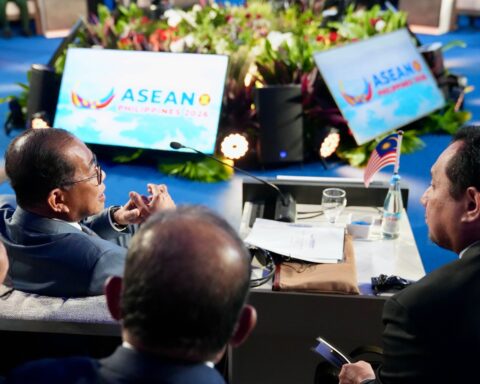
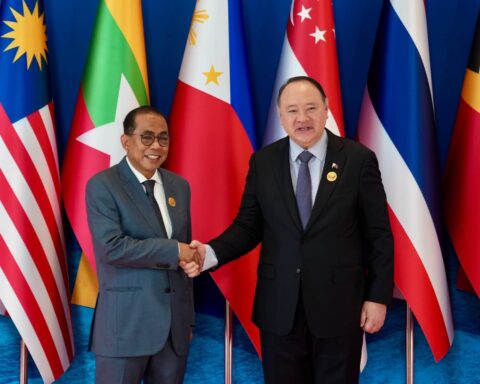
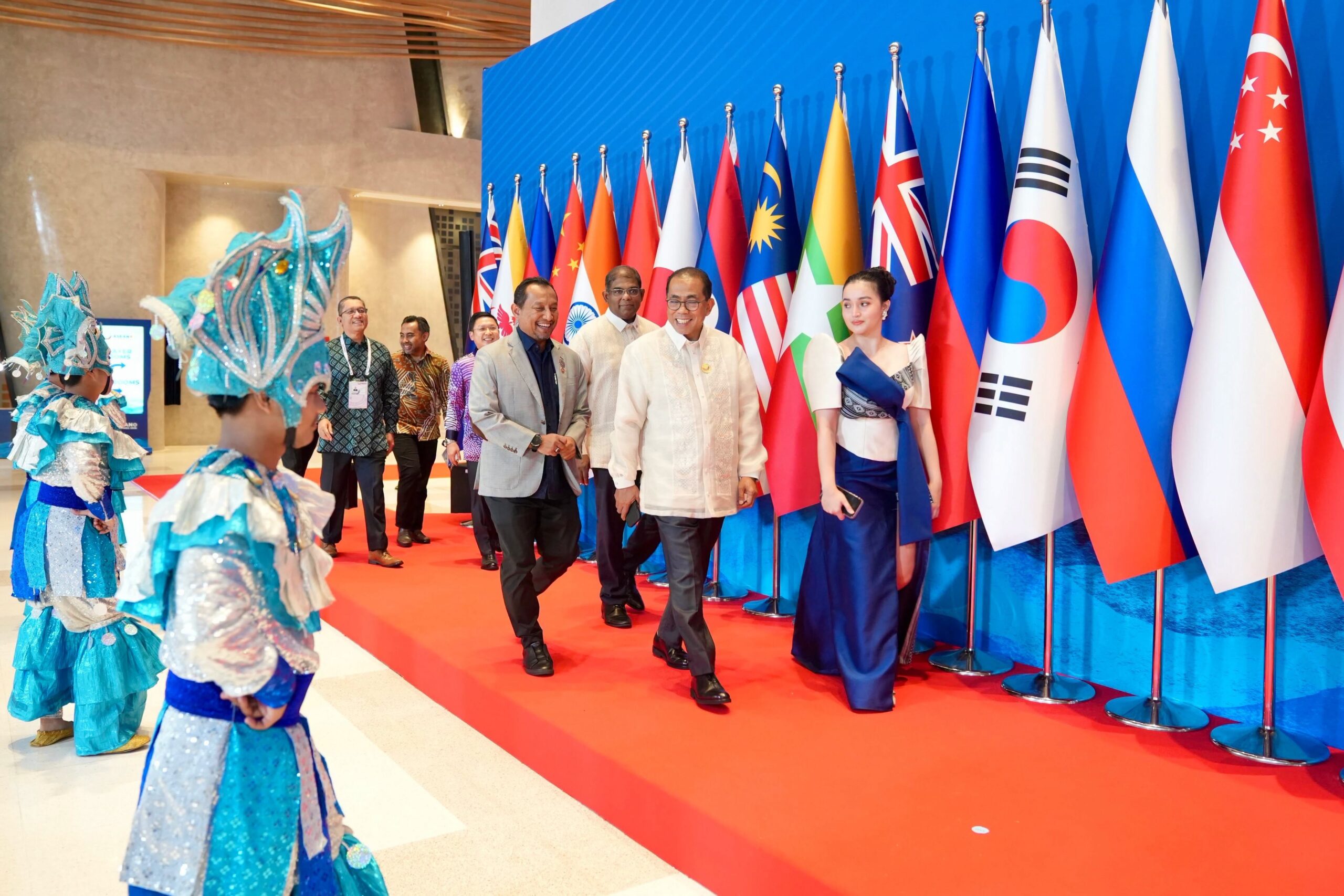
This is the dilemma Malaysia brought to Cebu, the Philippines, on 28 October 2026. In two informal meetings with the United States and Japan, Defence Minister Dato’ Seri Mohamed Khaled Nordin conveyed the same position to both. ASEAN’s approach has never been about choosing sides. ASEAN must remain firmly in the driver’s seat in deciding its partners and the priorities of its cooperation.
That position answers both findings above. Refusing to take sides answers the question of shifting choices. Its own capabilities answer the perception that ASEAN is slow. One thing is clear: the driver’s seat only means something when both demands are met at the same time.
Neutral Without a Position?
ASEAN’s reluctance to take sides is often misread as a sign that it has no position. Kuik Cheng-Chwee, Professor of International Relations at Universiti Kebangsaan Malaysia (UKM), reads this attitude through the concept of hedging. Small and middle powers in the region avoid fully siding with any great power while building fallback options in case circumstances change. Simply put, hedging is an insurance policy. The strategy demands close ties with all parties without handing strategic decisions to anyone.
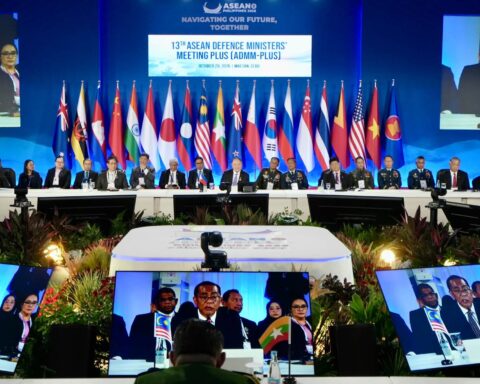
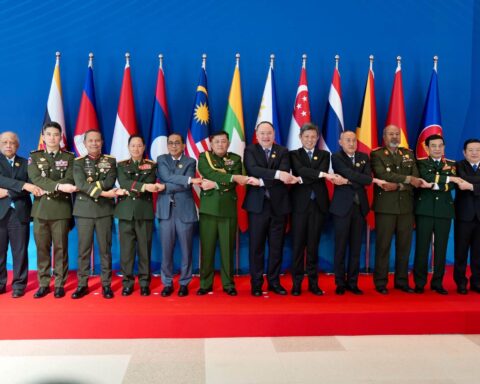
This strategy needs an arena, and ASEAN has long been building one. The ASEAN Defence Ministers’ Meeting-Plus (ADMM-Plus), established in 2010 and held every year since 2017, brings ASEAN defence ministers together with eight dialogue partners, including the United States, China, Russia and Japan. Only a handful of forums in the world can seat these competing powers at the same table.
It is in that arena that Malaysia spoke frankly with Washington. In its meeting with the United States Secretary of War, Pete Hegseth, Malaysia welcomed the United States’ presence as a Pacific nation and hoped for a stronger role. At the same time, a united and resilient ASEAN complements the role of the United States and is even the foundation for more meaningful cooperation. The test comes in 2027, when Malaysia looks forward to an ASEAN-United States defence cooperation framework on the 50th anniversary of the two sides’ dialogue relations.
Yet this success holds an irony. The great powers are willing to sit at ASEAN’s table because ASEAN threatens no one. The same quality is sometimes what makes ASEAN seem slow and not very effective. The question is whether ASEAN can become more effective without losing its ability to bring everyone together.
Capability Without Dependence
At bottom, the answer lies in the kind of capability that is built. ASEAN does not need to become a military alliance to be effective. Functional capabilities such as ceasefire monitoring and disaster relief can make ASEAN more effective without alarming any power. Malaysia’s relationship with Japan, for example, shows how.
A week before Cebu, the Defence Minister made a working visit to Japan from 18 to 21 October 2026, his first since taking office. The Official Security Assistance (OSA) 2026 document for an anti-drone system, worth ¥1.65 billion or about RM40 million, was signed. This assistance follows OSA 2023, worth ¥400 million for 14 unmanned aircraft and seven rescue boats, and OSA 2025, worth ¥3.1 billion.
What truly stands out is that part of OSA 2025 was allocated to equipment for the ASEAN Observer Team (AOT) on the Thailand-Cambodia border. Japan contributed resources, while the mechanism and its decisions remained ASEAN’s own.
This is the arrangement Malaysia asked for at the ASEAN-Japan meeting in Cebu: cooperation that avoids long-term dependence. Interestingly, the same ISEAS survey ranked Japan as the most trusted major power in the region, even though Japan is itself a close ally of the United States. That trust seems to be built through assistance that strengthens partners, rather than demands that partners take sides.
During the visit to Japan, procurement through government-to-government arrangements accompanied by technology transfer was also discussed, in line with the 30 per cent minimum local content target in the National Defence Industry Policy (DIPN). But the benefits of technology transfer depend on the readiness of local industry to understand and use it.
This need is explained by the concept of absorptive capacity, set out by Wesley Cohen and Daniel Levinthal in 1990. The two management scholars explained that an organisation’s ability to absorb outside knowledge depends on the knowledge it already holds. For the local defence industry, this means technology transfer must come with the development of skilled personnel and a knowledge base that lets the technology be mastered.
On that basis, the local defence industry must build engineers and test facilities before the technology arrives. Outside assistance without absorptive capacity is like hitching a ride on someone else’s ship. Sooner or later, it is the captain of that ship who decides the course.
Can ASEAN Drive on Its Own?
The seven Experts’ Working Groups (EWGs) will enter their sixth cycle for 2027 to 2030. The EWG observer programme for the 2024 to 2027 cycle has already opened places for Canada, France, Germany, Türkiye and the United Kingdom. Malaysia supports this openness on condition that ASEAN decides who is involved and the priorities of cooperation.
This openness must take into account the varying capacities of member states. At the 13th ADMM-Plus on 29 October 2026, the Defence Minister demanded that dialogue partners respect every ASEAN member state without exception. In practical cooperation, that respect should translate into an agenda that the member with the most limited resources can carry. Flexibility in implementation matters more than an ever-longer list of commitments.
From a more critical angle, the hardest weakness to overcome comes from within. If every new proposal is simply accepted, the regional agenda ends up being written by whoever offers the most assistance. ASEAN may win applause with a long list of cooperation, but the village is mortgaged when its own priorities are drowned out.
ASEAN must therefore come to every meeting with a jointly agreed list of capabilities for each EWG cycle. Dialogue partners’ assistance should fill the gaps that ASEAN itself has identified.
On the whole, the position the Defence Minister took to Cebu has a firm basis. The yardstick he set should also be held by every member state: the strength of a partnership is judged by its contribution to the region’s peace and resilience.
If ASEAN succeeds in building functional capabilities and arranging its own agenda, the Washington-or-Beijing question will lose much of its pressure. If it fails, ASEAN remains a respected host, but a host whose agenda is set by its guests.
Oo Cheng Keat is Director of the Political Science Programme and Senior Lecturer at the Faculty of Social Sciences and Humanities, Open University Malaysia (OUM).