Barisan Nasional’s (BN) victory in Johor was never seriously in doubt. Long before voters went to the polls, political observers had largely converged on the expectation that the coalition would secure another term in office. The only real uncertainty concerned the size of the mandate Johoreans were prepared to deliver.
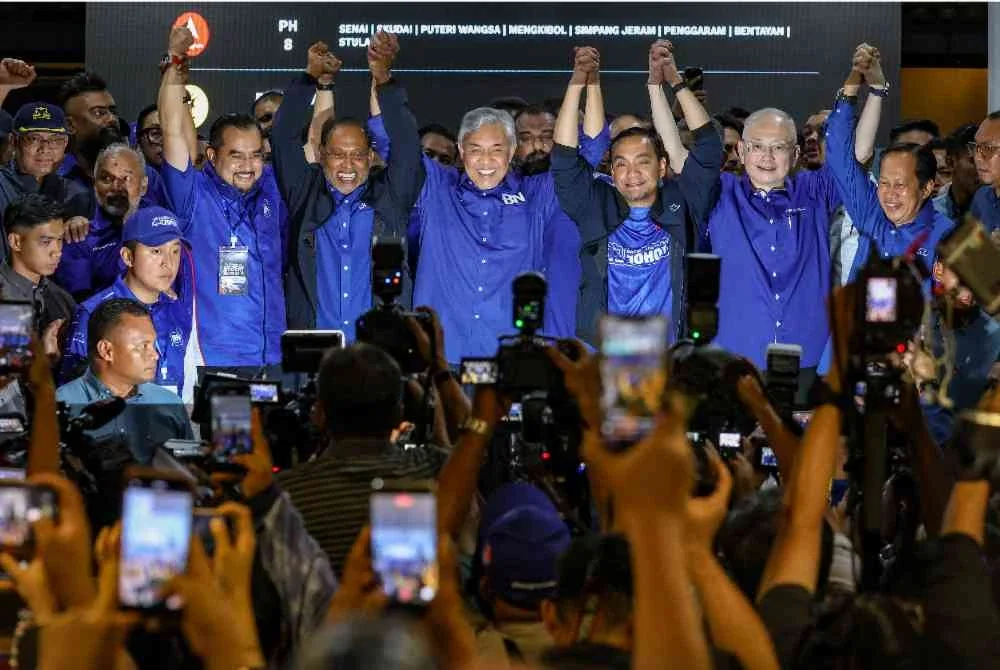
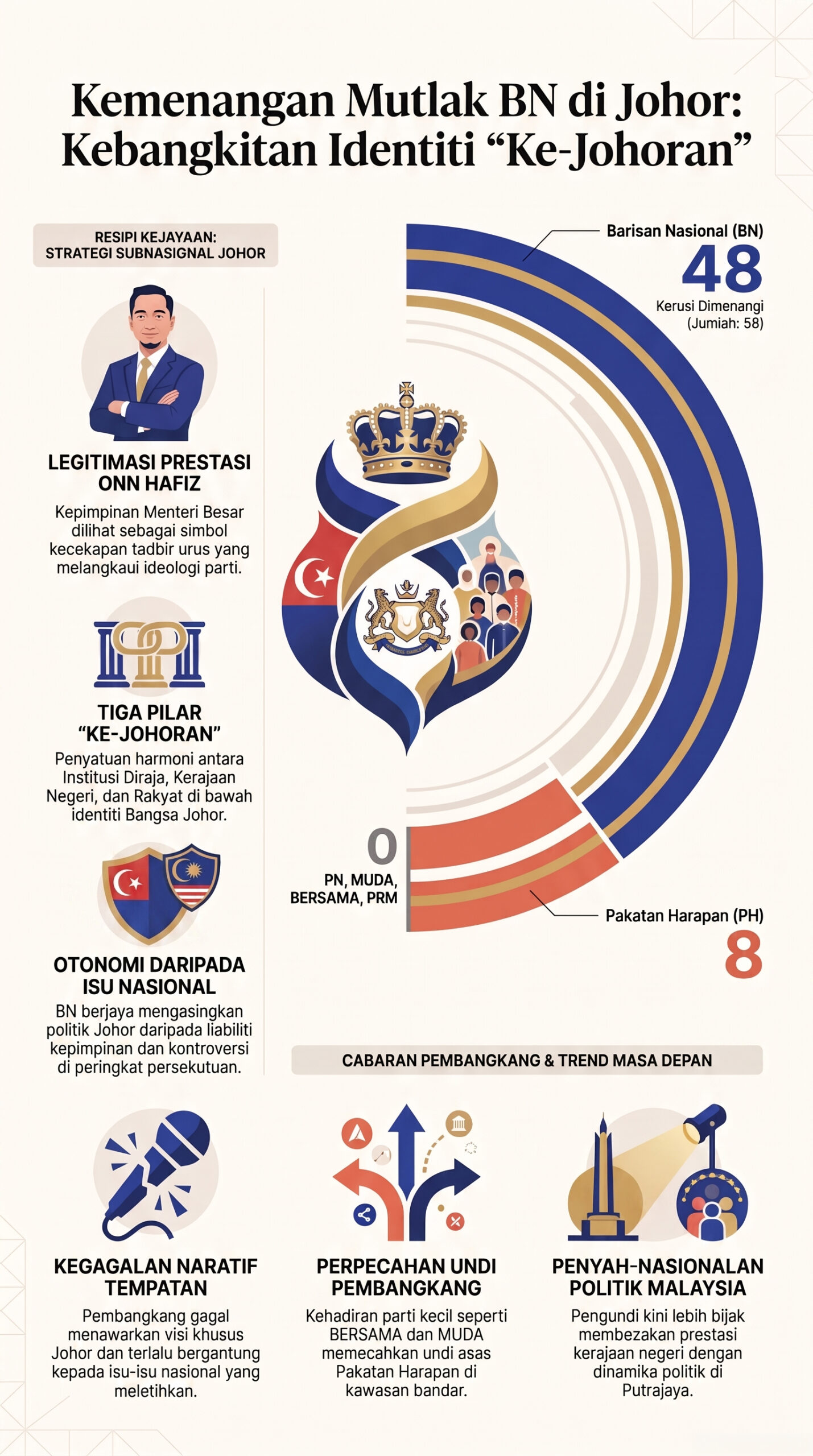
The result was emphatic. BN captured 48 of Johor’s 56 state assembly seats, eight more than it secured in 2022, while breaching several constituencies long regarded as Pakatan Harapan (PH) strongholds. PH was reduced to just eight seats, whereas Perikatan Nasional (PN), MUDA, Parti Rakyat Malaysia (PRM) and the newly formed BERSAMA failed to secure representation altogether. More than another electoral victory, the result reaffirmed BN’s political dominance in Johor and raised a more consequential question: why did the coalition win so decisively?
Much of the post-election analysis has focused on campaign organisation, electoral arithmetic, coalition dynamics and the mechanics of electoral competition. While these factors undoubtedly shaped the outcome, they offer only a partial account of BN’s dominance. A more compelling explanation lies in the interplay of less tangible forces, particularly political narratives, “Johorean” identity and evolving patterns of electoral behaviour. Rather than merely rewarding a political party, Johoreans appeared to endorse a particular model of state leadership, one that increasingly insulated Johor’s political trajectory from the turbulence of federal politics.
At the centre of this transformation stood Johor Menteri Besar Onn Hafiz Ghazi.
Even so, attributing BN’s victory solely to his personal popularity would be an overly simplistic interpretation. His significance extends well beyond conventional notions of electoral charisma. Onn Hafiz cultivated what political scientists describe as performance legitimacy, a form of political legitimacy derived not from ideology or personality alone, but from the public’s perception of competent governance. Over time, his political standing became inseparable from broader evaluations of the Johor state administration. His leadership evolved into a political shorthand for governmental performance, enabling BN candidates across the state to benefit from the credibility attached to his administration.
Even this explanation, however, remains incomplete.
Onn Hafiz’s popularity did not emerge in isolation, nor was it simply the product of effective governance. More consequential was his ability to redefine the terms of electoral competition. Instead of allowing Johor’s electoral discourse to be shaped by national political controversies, he successfully reconstructed state politics around a distinctly Johorean political imagination.
This governing framework, which may best be described as the “Ke-Johoran” (Johor political identity), rests upon the long-established relationship between three institutional pillars: the monarchy, the state government, and society. Together, they embody the enduring philosophy of Bangsa Johor, a governing tradition that has historically distinguished Johor from many other Malaysian states.
Historically, Johor’s political stability has often depended upon the ability of political leaders to maintain coherence across these three institutional pillars. When these relationships function harmoniously, Johor has traditionally projected an administration characterised by stability, administrative competence and a distinct sense of political sophistication.
By reinforcing these institutional linkages, BN gradually forged a state political identity that became increasingly autonomous from federal political contestation. In doing so, it cultivated subnational political consciousness, a political condition marked by territorial identity increasingly superseding national partisan loyalties as the principal determinant of electoral behaviour.
Viewed through this lens, BN Johor increasingly resembled a subnational political vehicle, moving beyond its role as the state chapter of a national coalition. Its legitimacy rested less on developments in Putrajaya than on Johor’s own political aspirations. The closest parallel is Gabungan Rakyat Sarawak (GRS), with political legitimacy similarly rooted in regional identity, territorial interests and a state-centred development agenda instead of federal partisan alignments.
Put simply, Onn Hafiz succeeded in making Johor vote as Johor.
The more important question, then, is why this strategy proved so politically effective at a time when BN continued to grapple with significant political liabilities at the national level.
Why Subnational Politics Favoured BN?
If subnational political consciousness proved decisive in Johor, it was largely because BN entered the election carrying a very different political reputation at the national level.
Eight years after losing federal power for the first time, BN has yet to fully reconstruct its national electoral appeal. Much of its senior leadership remains associated with an older political generation increasingly viewed as politically exhausted. Equally significant is BN’s cooperation with the Democratic Action Party (DAP), a partnership that many segments of the Malay electorate continue to regard as breaking one of the unwritten rules of Malay politics. The persistent “UMDAP” narrative, regardless of its empirical accuracy, remains a political liability capable of shaping voter perceptions.
Johor therefore confronted a political challenge distinct from that facing the rest of the country. Onn Hafiz responded by insulating Johor politics from the coalition’s federal political baggage. He deliberately projected the state administration as a politically autonomous government, drawing its legitimacy from its own governing record instead of the fortunes or controversies surrounding the federal coalition. This distinction proved crucial. The campaign did not ask Johoreans to endorse BN as a national brand. It invited them to judge Johor on its own terms.
That political autonomy, nevertheless, could not rest on rhetoric alone.
Onn Hafiz understood this well. Revitalising Bangsa Johor therefore became more than a symbolic exercise. It evolved into an inclusive governing philosophy that consistently reached across ethnic boundaries, including the Orang Asli community. Rather than allowing communal politics to dictate the state’s political trajectory, Johor increasingly presented itself as a collective political community united by shared state interests and a common developmental agenda.
The second pillar was administrative performance. Throughout his tenure, the Johor government consistently projected an image of policy continuity, bureaucratic competence and responsive governance. Elections rarely reward governments for making promises alone. They reward governments that persuade voters they have already delivered.
The third, and perhaps most underestimated, was the relationship between the state government and the Johor monarchy. Unlike many other Malaysian states, the monarchy occupies a uniquely influential position within Johor’s political culture. Maintaining a stable, respectful and constructive relationship with the Palace therefore carries significance far beyond constitutional convention. It reinforces perceptions of institutional stability, administrative maturity and political continuity, qualities that remain highly valued among Johoreans.
Yet governance alone seldom wins elections. The decisive battleground was interpretation.
BN’s greatest strategic advantage lay in its ability to shape how voters interpreted governmental performance. Public policies, development initiatives and administrative achievements were woven into a broader political narrative centred on stability, competent leadership and Johor’s continued progress. Governance was transformed into narrative, and narrative into political capital.
In political communication, this is commonly understood as narrative ownership: the ability to shape not merely political debate, but the meaning voters attach to political performance. Throughout the campaign, BN largely dictated that meaning, forcing its opponents to campaign within a narrative they did not control.
Its electoral effects became particularly visible among segments of the Chinese electorate.
Chinese voting behaviour in Malaysia has historically been characterised by pragmatism. Electoral support has seldom been unconditional, instead reflecting assessments of governmental competence, economic management and administrative performance. Although recent elections pointed towards stronger party identification, particularly with DAP, Johor’s 2026 election suggested a partial return to this longer-standing pattern of pragmatic voting.
The modest swing towards MCA should therefore be understood less as a revival of the party than as a growing willingness among sections of the Chinese electorate to distinguish their assessment of Johor’s state administration from their views of national politics. Their votes reflected confidence in the state government’s performance, not necessarily renewed support for MCA itself.
This shift also reflected growing doubts over DAP’s continued ability to function as the principal representative of Chinese political interests within the federal governing coalition. Numerically, these changes were modest. Strategically, however, they proved highly consequential. In closely contested mixed constituencies, even limited electoral movement was sufficient to reshape electoral outcomes. Collectively, these developments contributed to PH’s electoral decline.
A Failure to Convince
The coalition never succeeded in making a persuasive case for replacing the incumbent Johor government. Much of its electoral strategy remained anchored in national political controversies while offering remarkably little in the way of a compelling Johor-specific vision. Whereas BN framed the election around Johor’s future, PH repeatedly invited voters to revisit federal grievances.
That proved to be a costly miscalculation.
The coalition underestimated the degree of state-centred political thinking that had come to shape Johor voters’ electoral choices. As BN consolidated its ownership of Johorean identity, PH struggled to articulate a state-centred narrative that could compete on the same political terrain.
These weaknesses were further compounded by organisational deficiencies. PH entered the election without a commanding state-level figure capable of unifying its electoral effort and projecting a credible leadership alternative. Several avoidable tactical missteps, including the delayed launch of its manifesto and subsequent accusations that key policy proposals closely resembled BN’s own platform, reinforced perceptions of an opposition campaign lacking strategic coherence.
Leadership ambiguity further weakened PH’s electoral positioning. Although prominent figures such as Maszlee Malik featured throughout the campaign, none succeeded in cultivating the candidate-centred politics already established by Onn Hafiz. BN entered the election with both a recognisable leader and a coherent governing narrative. PH entered with neither.
PH was not alone in struggling to adapt to Johor’s changing political landscape. Perikatan Nasional (PN) confronted a different, though equally damaging, problem. Its greatest weakness lay less in campaign organisation than in political credibility. Parties unable to manage internal divisions rarely convince voters that they possess the discipline and competence required to govern.
Johor presented voters with a straightforward benchmark. Bersatu had previously held the office of Menteri Besar on two separate occasions, leaving behind two administrations open to direct public evaluation. Neither succeeded in establishing a governing legacy strong enough to challenge BN’s incumbency. PN therefore entered the election having largely exhausted its valence advantage.
Absent a powerful national wave driven by Malay-Muslim issues involving UMNO, or a major state-level crisis, PN had little opportunity to overcome its credibility deficit. The challenge became even greater as both PN and BN/UMNO competed for broadly the same segment of the Malay electorate. Persuading voters to abandon an incumbent government demanded more than ideological affinity. It required confidence that the alternative could govern more effectively. PN never inspired that confidence.
The election also exposed another structural weakness across the opposition: fragmentation. BERSAMA illustrated this most clearly. Although the party failed to secure a single seat, its political impact extended beyond parliamentary representation. In constituencies such as Bukit Batu and Perling, BERSAMA diverted enough opposition votes to alter the electoral balance.
BERSAMA functioned less as an alternative to BN than as an alternative for dissatisfied PH supporters. Most of its support appeared to originate from within the broader opposition camp, while defections from BN remained limited. The political fallout surrounding Rafizi Ramli further intensified this trend, accelerating the fragmentation of PH’s urban support base at a decisive stage of the campaign.
MUDA’s predicament differed from that of BERSAMA but proved no less consequential. Following the departure of Syed Saddiq Syed Abdul Rahman, the party struggled to redefine both its political identity and strategic direction. Its new leadership has yet to establish comparable political visibility or public confidence, while efforts to build a credible second generation of leadership remain incomplete. Johor laid bare those structural weaknesses. As electoral competition increasingly revolved around coherent state-level narratives, MUDA failed to articulate a distinctive political identity capable of setting itself apart from the broader opposition. The campaign frequently prioritised issues with limited cross-demographic appeal while overlooking concerns more closely aligned with Johor’s state-level political agenda.
Beyond Johor
The broader significance of Johor’s election extends well beyond the state’s electoral outcome. More fundamentally, it suggests that Malaysian politics may be entering a period characterised by the gradual de-nationalisation of electoral competition. State elections are becoming increasingly detached from federal political dynamics as voters distinguish more clearly between state and national governments.
Johor offers perhaps the clearest illustration of this shift. Voting behaviour increasingly reflected retrospective evaluations of governmental performance, giving greater electoral weight to administrative credibility, leadership and locally grounded political narratives than to national political controversies.
This emerging pattern also suggests that parties may increasingly benefit from high-profile political figures capable of embodying those narratives. Johor demonstrated how an incumbent leader transformed governing performance into political legitimacy. Other states may follow a different path. Electoral advantage may arise from incumbency, as in Johor, or from personal popularity and political stature.
Negeri Sembilan may provide the next important test. Should Khairy Jamaluddin emerge as the coalition’s principal electoral figure, his personal popularity could reshape the state’s political dynamics despite the absence of incumbency. Whether that popularity can ultimately be converted into electoral success will depend on his ability to construct a compelling state-level political narrative.
For that reason, Johor should not be read as a straightforward predictor of Malaysia’s sixteenth general election. It instead points to a broader transformation in Malaysian politics. State contests are increasingly shaped by local leadership, administrative performance and regional political identity, with national partisan competition becoming progressively less decisive.
 Shah Mohd Akmal Abdul Halim is a PhD candidate at the Institute of Ethnic Studies (KITA), Universiti Kebangsaan Malaysia (UKM). He holds a Master’s degree in Political Science from UKM. His research interests include Malaysian politics, Malay politics, ethnic politics, electoral behaviour, and the intersection of artificial intelligence and politics.