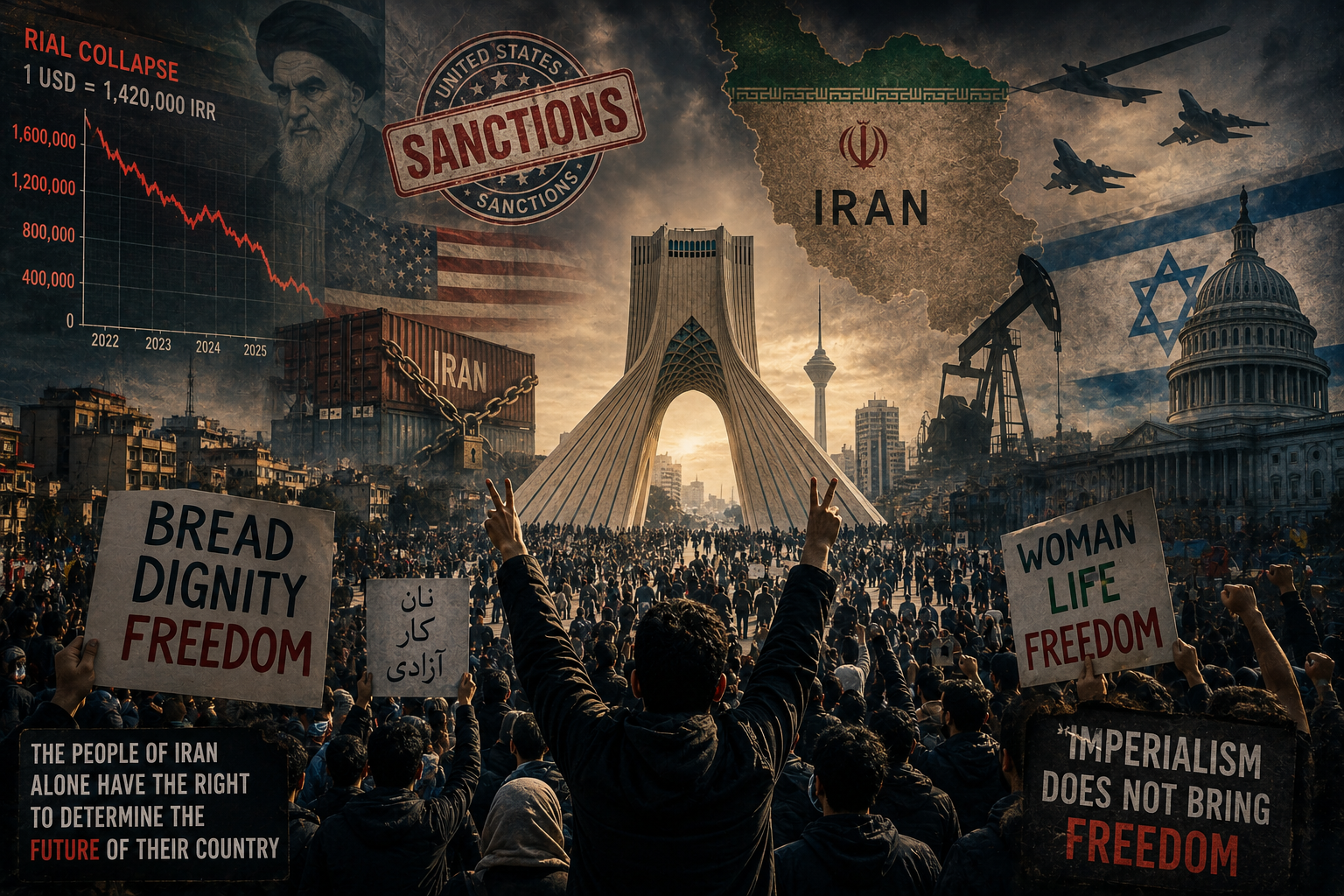
Amid a deepening economic crisis in Iran, protests that began as a movement of workers and traders in December last year in Tehran’s bazaar have now spread across the country, developing into a mass uprising for livelihood, dignity, and democratic rights. Protests are unfolding across Iran as workers organise strikes and pickets in several sectors, and students rise up in resistance despite repression unleashed by the forces of the theocratic regime. According to reports, several people have been killed, with widespread violence reported from across the country, including the capital city of Tehran.
At the same time, as the Iranian people fight for bread and liberty, we are witnessing cynical attempts by US imperialism, the Israeli Zionist state and forces linked to the deposed brutal Shahist monarchy to infiltrate and hijack the movement and further their own Islamophobic narrative and clamour for regime change. The Trump regime, emboldened by its recent aggression against Venezuela and the bombing in Iran in 2025 and driven by imperial hubris, uses the pretext of “standing with the people of Iran” to recolonise the country politically and economically and subjugate its people, just as the United States did in 1953 through the CIA‑orchestrated coup (Operation Ajax) against the democratically elected government of Mohammad Mosaddegh.
The economic crisis in Iran is inseparable from the criminal sanctions imposed by the United States and Western powers, which amount to collective punishment of an entire population. They have devastated livelihoods, weakened public services and deepened inequality. This crisis is further aggravated by a monopolistic economic model within Iran that concentrates wealth and power in the hands of a few individuals and foundations, while working class and toiling masses are made to bear the burden.
Like many historic struggles in Iran, including the 2022 Zan, Zendegi, Azadi (Woman, Life, Freedom) movement, the ongoing protests reflect the anger of the people against a tyrannical economic and political system that has for decades crushed democratic rights, suppressed trade unions and popular struggles, and denied freedom of association.
We stand in solidarity with the democratic and working-class movements of Iran that have called for strengthening the struggle for livelihood and liberty against the repressive regime and for firmly rejecting any attempts to push the country back into the tyranny of monarchy or to exploit the protests as a pretext for imperialist intervention. The people of Iran alone have the right to determine the future of their country.
— Central Committee, Communist Party of India (Marxist-Leninist) Liberation | cpiml.org | January 12, 2026
Iran occupies a singular and uncomfortable position in the political imagination of the Global South. It is at once a state forged through anti-imperialist rupture and one increasingly burdened by the contradictions of post-revolutionary governance under conditions of permanent external siege. The present wave of mass demonstrations spreading across more than one hundred towns and provinces since late December cannot be adequately understood through the reductive moral binaries of “regime versus people” that dominate Western media narratives. Such framings obscure more than they reveal. What confronts Iran today is not a sudden eruption of irrational discontent nor a simple authoritarian backlash against freedom, but the cumulative outcome of prolonged economic strangulation, structural stagnation, and political exhaustion, sharpened and exploited by ever-present imperial intervention.
As the protests moved into their extreme, the Iranian state responded in a manner familiar to governments operating under siege: sweeping internet restrictions, communication blackouts, and the securitisation of public space. Casualty figures remain contested and opaque. Semi-official Iranian sources report more than one hundred security personnel killed, while Western media outlets cite figures of several hundred demonstrators dead. In the context of information warfare, sanctions regimes, and tightly controlled communication channels, numbers themselves become political instruments, mobilised to serve competing narratives of legitimacy and condemnation. Yet beyond the contest over figures lies a more concrete and less disputable reality: Iran’s working population is under severe and escalating material pressure, and the social contract that once underpinned post-revolutionary stability has been steadily eroded.
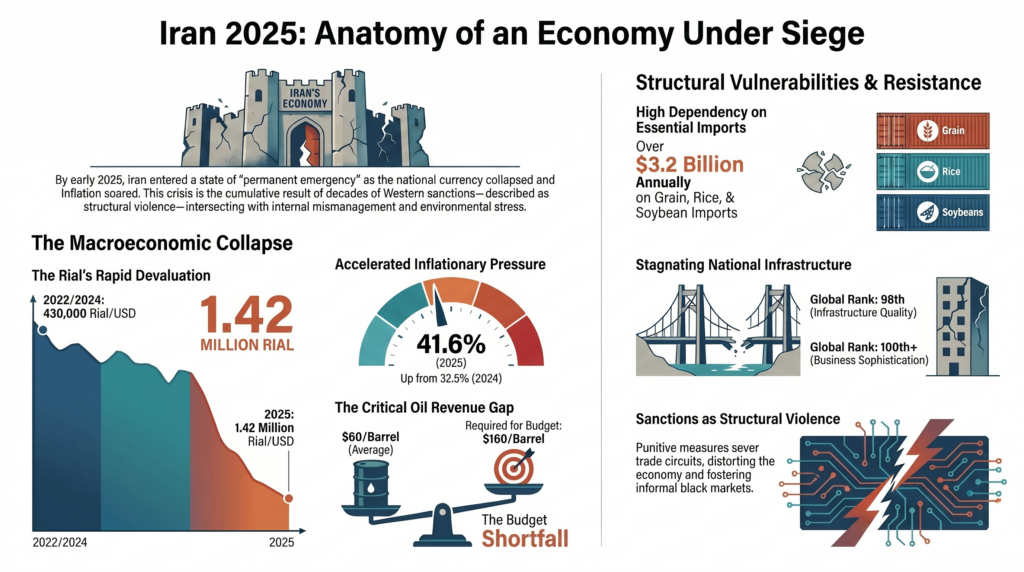 The immediate trigger of the protests was economic, but their deeper causes lie in the structural deformation of an economy subjected to prolonged isolation from global trade on punitive terms. By early 2025, the Iranian rial had collapsed to approximately 1.42 million rial to the US dollar, marking one of the sharpest currency depreciations in the contemporary Global South. This collapse was not a sudden accident but the predictable culmination of years of sanctions, capital flight, and constrained export capacity. In 2022, when Mohammad Reza Farzin assumed the governorship of Iran’s Central Bank, the exchange rate stood at roughly 430,000 rial to the dollar. Within three years, the currency had lost more than two-thirds of its value, wiping out savings, destabilising prices, and accelerating the informalisation of economic life. Farzin’s subsequent resignation was less a personal failure than a symbolic acknowledgement of the state’s limited capacity to manage an economy under siege.
Inflation followed a similarly destructive trajectory. According to IMF estimates, Iran’s inflation rate reached approximately 41.6 percent in 2025, rising from an already debilitating 32.5 percent the previous year. These figures, while alarming in aggregate, only hint at the lived experience of inflation in a highly import-dependent economy. Iran relies heavily on imported foodstuffs and agricultural inputs, including grain imports valued at roughly USD 1.27 billion annually, rice imports of around USD 737 million, and soybean imports exceeding USD 1.2 billion. As the rial depreciates, the domestic price of these essentials rises disproportionately, transmitting inflationary pressure across the entire consumption basket. Food inflation, in turn, erodes real wages more rapidly than headline figures suggest, particularly for urban workers, pensioners, and the rural poor.
The inflationary spiral has been compounded by long-standing environmental and infrastructural constraints. Iran has faced recurrent droughts and chronic water shortages for over a decade, undermining agricultural productivity and intensifying regional inequalities. Food security has emerged as a persistent concern, with international food agencies warning of growing vulnerability among lower-income households. The state’s capacity to cushion these shocks through subsidies has been progressively weakened by fiscal constraints, themselves a direct consequence of sanctions-induced revenue shortfalls. What emerges, therefore, is not a picture of economic mismanagement in isolation, but of an economy structurally deformed by external coercion and internal limitation alike.
To acknowledge the centrality of sanctions, however, is not to absolve Iran’s governing elite of responsibility. The post-revolutionary state has struggled to translate political sovereignty into sustained developmental transformation. Corruption, bureaucratic inefficiency, and uneven infrastructural investment have constrained growth and exacerbated social frustration. International indicators offer a partial reflection of these weaknesses. Iran’s ranking in global infrastructure indices hovers around the lower end of the middle tier, while measures of business sophistication and technological integration place it closer to the bottom third of world economies. Agricultural productivity remains hampered by outdated techniques, limited mechanisation, and insufficient investment in water management, while industrial upgrading has been uneven and slow. Yet to isolate these deficiencies from their geopolitical context is to reproduce a familiar ideological manoeuvre, one that locates failure exclusively within the domestic sphere while treating external pressure as incidental. Iran’s economic trajectory over the past two decades has been decisively shaped by sanctions that function less as diplomatic instruments than as forms of structural violence. Despite possessing substantial oil and gas reserves, Iran’s capacity to export energy has been severely constrained by restrictions on shipping, insurance, banking, and payment systems. Even when exports occur, they are often routed through intermediaries, sold at discounted prices, or subject to delayed payment, further eroding state revenue.
The volatility of global energy markets has intensified these pressures. In 2025, crude oil prices fell to approximately USD 60 per barrel, a level insufficient for Iran to meet its fiscal needs under existing expenditure commitments. Estimates suggest that Iran requires oil prices closer to USD 160 per barrel to balance its budget without resorting to inflationary financing. The gap between these figures represents not merely a budgetary shortfall but a structural impossibility imposed by a hostile international environment. Under such conditions, fiscal discipline becomes politically explosive, while monetary expansion fuels inflation and currency depreciation. The resulting dilemma has no technocratic solution. The brief easing of sanctions following the nuclear agreement reached under the Obama administration offered a glimpse of an alternative trajectory. During this period, Iran experienced modest growth, improved access to foreign exchange, and a partial stabilisation of prices. This fragile recovery was abruptly reversed in 2018, when the Trump administration unilaterally withdrew from the agreement and reinstated comprehensive sanctions. The consequences were immediate and severe, triggering capital flight, accelerating inflation, and collapsing investor confidence. The decision was not driven by concern for Iranian democracy or human rights, but by a strategic calculus aimed at reasserting American dominance in West Asia and constraining Iran’s regional influence.
It is against this backdrop that the current protests must be situated. Popular anger in Iran is real, rooted in material deprivation and political disillusionment. Yet it unfolds within an international environment saturated with imperial opportunism. The United States and Israel, neither of which has ever concealed its desire for regime change in Tehran, have been quick to frame the unrest as evidence of the regime’s impending collapse. Public statements threatening punitive action, intelligence agencies encouraging protest through social media channels, and symbolic gestures by Western tech elites all point to a concerted effort to appropriate popular discontent for geopolitical ends. Such interventions are not expressions of solidarity but of strategic calculation. History offers abundant evidence of the dangers inherent in this dynamic. From the 1953 coup that overthrew Mohammad Mossadegh to the orchestration of regime change in Chile in 1973, imperial powers have repeatedly exploited genuine social grievances to restore compliant elites and dismantle autonomous development projects. The rhetoric of liberation has consistently masked the realities of economic dependency, political repression, and renewed subordination. There is no reason to believe that Iran would be an exception.
The danger, therefore, is not protest itself, but its capture. A movement rooted in demands for economic justice and political accountability can be derailed when external actors seek to redefine its objectives and leadership. The language of human rights, selectively deployed, becomes a means of delegitimising sovereignty rather than empowering citizens. In such contexts, the distinction between internal reform and external intervention is not merely semantic but existential. This does not negate the legitimacy of domestic critique. The Iranian state has, over time, narrowed the space for political participation and pluralism, contributing to a sense of alienation among younger generations. Economic hardship has intersected with cultural and social restrictions to produce a pervasive atmosphere of frustration. President Masoud Pezeshkian’s recent statements acknowledging the need for fundamental reform signal an awareness of this crisis, but such declarations will carry weight only if translated into substantive policy shifts and institutional change. Reform, if it is to be meaningful, must be driven by sustained popular pressure rather than episodic unrest, and it must address the material foundations of discontent rather than merely its symbolic expressions.
For observers in the Global South, the appropriate stance is one of critical solidarity. This entails rejecting both authoritarian repression and imperial manipulation, recognising that the Iranian people face constraints from above and from outside. It requires an understanding that economic sovereignty and political reform are not mutually exclusive but mutually reinforcing. A state under siege is less likely to liberalise, just as a repressive state is less capable of mobilising popular resilience against external pressure. Iran’s continued role as a critical voice against imperial domination in international forums remains significant, particularly at a moment when the global order is marked by renewed great-power rivalry and the erosion of multilateral norms. Yet such a role cannot be sustained through rhetoric alone. It depends on the state’s capacity to secure the material well-being and political dignity of its population. Anti-imperialism divorced from social justice risks degenerating into empty posturing, while social justice pursued without regard for sovereignty risks absorption into imperial designs.
The present crisis, then, should be understood not as a terminal moment but as a conjuncture, shaped by long-term structural forces and immediate political choices. The outcome is not predetermined. Iran’s history demonstrates a remarkable capacity for endurance and adaptation, forged through decades of external pressure and internal contestation. Whether this capacity can be mobilised in the service of genuine reform rather than renewed repression or external subordination remains an open question. What is clear is that simplistic narratives serve no one but those who benefit from disorder. To reduce Iran’s crisis to a morality play is to deny the complexity of its political economy and the agency of its people. To frame external intervention as benevolent concern is to ignore the historical record of imperial engagement in the region. A more sober analysis recognises that popular anger in Iran is both justified and vulnerable, rooted in real suffering yet exposed to manipulation for Iranians and for observers alike, is to insist that the voices shaping Iran’s future emerge from within its society rather than from foreign capitals. Solidarity must be grounded in respect for sovereignty, and critique must be informed by an understanding of structural constraint. Only then can the struggle for bread be reconciled with the defence of independence, and the demand for reform be insulated from the ever-present hand of empire.
An Economy Under Siege
At the core of Iran’s present unrest lies not a sudden moral awakening nor a spontaneous political revolt, but the slow, grinding collapse of an economy subjected to sustained external pressure while burdened by internal structural limits. By early 2025, the Iranian rial had deteriorated to approximately 1.42 million to the United States dollar, a level that would once have seemed inconceivable even to Iran’s harshest critics. This collapse was not merely a technical failure of monetary management; it was the visible symptom of a deeper and longer process of economic attrition. In 2022, when Mohammad Reza Farzin assumed the governorship of the Central Bank of Iran, the exchange rate stood at roughly 430,000 rial to the dollar. Within three years, the currency had lost well over two-thirds of its value, annihilating savings, destabilising prices, and rendering long-term economic planning impossible for households and firms alike. Farzin’s resignation, widely reported as a response to the currency crisis, should be read less as an admission of personal incompetence than as an acknowledgment of the structural constraints imposed on any monetary authority operating under conditions of near-total financial isolation.
Inflation followed inexorably. According to International Monetary Fund estimates, Iran’s inflation rate reached approximately 41.6 per cent in 2025, rising from an already punishing 32.5 per cent the previous year. Such figures, while striking in comparative terms, understate the lived reality of inflation in an economy where wages lag prices, informal employment expands, and state subsidies are progressively eroded. For ordinary Iranians, inflation is not an abstract macroeconomic imbalance but a daily assault on subsistence: the shrinking of food portions, the abandonment of medical care, the postponement of marriage, the quiet liquidation of household assets. In such conditions, the social meaning of money itself is transformed. Currency ceases to function as a stable store of value and becomes instead a rapidly depreciating medium of desperation, to be exchanged as quickly as possible for goods whose prices rise by the week, sometimes by the day.
This dynamic is intensified by Iran’s structural dependence on imports for basic consumption. Despite its size, population, and natural resource endowment, Iran relies heavily on imported foodstuffs and agricultural inputs. Annual grain imports amount to approximately USD 1.27 billion, rice imports to around USD 737 million, and soybean imports to roughly USD 1.24 billion. These are not luxuries but staples, integral to the caloric intake of the population and to the functioning of domestic food processing industries. As the rial collapses, the domestic price of these imports rises sharply, transmitting inflationary pressure across the entire economy. Food inflation, in turn, spills over into transport costs, wage demands, and rent, producing a cumulative effect that disproportionately burdens low-income households. The urban poor, pensioners, and fixed-income workers experience this pressure most acutely, while those with access to foreign currency or speculative assets are partially insulated, widening existing inequalities.
The inflationary crisis has been compounded by long-standing environmental and infrastructural constraints. Iran has faced recurrent droughts and chronic water shortages for over a decade, undermining agricultural productivity and exacerbating regional disparities. Poor water management, outdated irrigation systems, and the overexploitation of aquifers have left large swathes of the countryside vulnerable to crop failure. As domestic agricultural output stagnates or declines, reliance on imports increases, further exposing the economy to currency volatility. International food agencies have repeatedly warned that food security constitutes a major and growing challenge for Iran, particularly in rural and peripheral regions. Yet the state’s capacity to respond through subsidies or strategic reserves has been steadily weakened by fiscal constraints imposed from outside.
To describe Iran’s economic predicament as the product of mismanagement alone is to ignore the decisive role of sanctions as instruments of structural violence. Over the past two decades, Iran has been subjected to one of the most comprehensive sanctions regimes ever imposed on a middle-income country. These measures extend far beyond restrictions on trade in specific goods. They encompass financial transactions, shipping insurance, access to international payment systems, and even the procurement of spare parts for civilian infrastructure. The cumulative effect has been to sever Iran from the circuits of global capital and trade on which modern industrial economies depend, while leaving it exposed to the volatility of global commodity markets without the usual mechanisms of risk mitigation.
Despite possessing substantial oil and gas reserves, Iran’s capacity to export energy has been severely constrained. Sanctions limit not only the volume of exports but also their profitability. Oil sold under such conditions is often discounted, routed through intermediaries, or paid for in ways that restrict its usability, such as barter arrangements or frozen accounts. Revenue is delayed, diminished, or rendered inaccessible, undermining the state’s ability to plan and invest. In this context, fluctuations in global oil prices assume an exaggerated significance. In 2025, crude oil prices fell to approximately USD 60 per barrel, a level far below what Iran requires to sustain fiscal balance. Estimates suggest that Iran would need prices closer to USD 160 per barrel to meet its expenditure commitments without resorting to inflationary financing. The gap between these figures represents not merely a budgetary challenge but a structural impossibility, one that no amount of technocratic adjustment can resolve. Under such conditions, monetary expansion becomes an almost inevitable response. Faced with declining real revenues and rising social demands, the state turns to domestic credit creation to bridge the gap. The result is a self-reinforcing cycle of inflation and currency depreciation. Attempts to stabilise the rial through administrative controls or multiple exchange rates introduce new distortions, encouraging rent-seeking and arbitrage while eroding public trust. The economy becomes increasingly informal, as households and firms seek refuge in cash transactions, foreign currency hoarding, and speculative activity. Long-term productive investment declines, further constraining growth and employment. The social consequences of this economic siege are profound. Youth unemployment remains high, even among university graduates, while underemployment and precarious work proliferate. Small traders and artisans, traditionally a stabilising social force in Iranian cities, find themselves squeezed between rising input costs and declining consumer purchasing power. Rural households face the combined pressures of environmental stress and market volatility, accelerating migration to urban peripheries ill-equipped to absorb new residents. The resulting social landscape is one of pervasive insecurity, in which economic grievances readily acquire political expression.
Yet the very severity of Iran’s economic difficulties has made them attractive to external actors seeking to advance geopolitical objectives. The language of humanitarian concern is selectively mobilised to justify policies that exacerbate suffering, while responsibility for that suffering is displaced onto domestic governance alone. Sanctions are framed as tools of moral pressure rather than as mechanisms of collective punishment. The fact that inflation, food insecurity, and currency collapse are predictable consequences of such measures is treated as incidental, if acknowledged at all. In this way, economic hardship is depoliticised at the international level even as it radicalises politics at home. The brief period of sanctions relief following the nuclear agreement under the Obama administration demonstrated the contingent nature of Iran’s economic isolation. During that interval, Iran experienced modest growth, improved access to foreign exchange, and partial price stabilisation. These gains were fragile but real, suggesting that the economy’s underlying productive capacity had not been irreparably destroyed. The unilateral withdrawal of the United States from the agreement in 2018 and the subsequent reimposition of sanctions abruptly reversed this trajectory. Capital fled, inflation surged, and the rial entered a new phase of decline. The decision was justified in the language of security and non-proliferation, but its economic effects were unmistakably punitive, aimed at weakening the state by eroding the material foundations of social stability.
In this context, popular unrest emerges not as an aberration but as a rational response to sustained deprivation. The protests that have spread across Iran reflect a convergence of grievances rooted in everyday experience: the inability to afford basic foodstuffs, the collapse of savings, the absence of meaningful employment prospects. These grievances are not confined to any single class or region but cut across urban and rural divides, binding together disparate social groups in shared frustration. Yet the articulation of these grievances occurs within a political environment shaped by decades of external hostility, rendering any movement for change vulnerable to appropriation. The danger lies not in the expression of economic anger itself but in its redirection. External powers, long hostile to Iran’s autonomy, have shown little hesitation in exploiting moments of internal weakness. Calls for regime change, issued from capitals responsible for much of Iran’s economic distress, ring hollow to those who recall earlier episodes of intervention. The history of the region offers no shortage of examples in which popular discontent has been harnessed to install regimes more amenable to foreign interests, at immense cost to local populations.
To recognise the structural origins of Iran’s economic crisis is not to deny the need for domestic reform. Corruption, inefficiency, and unequal development have aggravated the impact of sanctions and undermined public confidence. But reform undertaken under siege faces inherent limits. A state deprived of external revenue, constrained in its trade, and subjected to constant threat is less able, not more, to implement redistributive policies or invest in long-term development. The paradox is that external pressure, ostensibly applied to promote change, often entrenches the very conditions it claims to oppose. Iran’s economy, then, should be understood as operating under conditions of permanent emergency, where policy choices are shaped as much by geopolitical constraint as by domestic preference. The resulting high inflation, currency collapse, and food insecurity are neither accidental nor unique. They mirror patterns observed in other societies subjected to prolonged sanctions, from Iraq in the 1990s to Venezuela more recently. In each case, the burden falls heaviest on those least responsible for political decisions, while elites adapt through access to privileged channels of exchange.
The present unrest reflects the exhaustion of a population asked to endure indefinite sacrifice in the name of sovereignty without seeing commensurate improvements in material life. Yet sovereignty itself remains a central concern, not least because its erosion has historically produced outcomes even more devastating. The challenge facing Iran is therefore not simply to restore economic stability but to do so in a manner that preserves autonomy while addressing social justice. This is a formidable task, made more difficult by an international environment that rewards compliance and punishes independence. Any serious analysis of Iran’s crisis must begin with the recognition that an economy under siege behaves differently from one integrated into global markets on equitable terms. Conventional prescriptions—fiscal austerity, monetary tightening, market liberalisation are ill-suited to conditions of enforced isolation. What appears as policy failure may in fact be the manifestation of structural constraint. To ignore this is to misread both the causes of unrest and the possibilities for resolution. The unrest now visible on Iran’s streets is thus inseparable from the silent violence of economic siege. Bread and currency, food security and exchange rates, inflation and sanctions are not peripheral details but the substance of political life. Until these material conditions are addressed, calls for stability or reform will ring hollow. And until the role of external pressure is acknowledged, any narrative that places responsibility solely within Iran’s borders will remain profoundly incomplete.
Governance Failures, But Not in a Vacuum
To locate Iran’s present crisis exclusively in the realm of external pressure would be analytically evasive and politically indulgent. The Iranian state does indeed suffer from serious domestic failures, and these failures have accumulated over decades rather than years. Corruption has become systemic rather than incidental, bureaucratic inefficiency structural rather than episodic, and infrastructural stagnation a persistent constraint on productive development. International indicators, limited though they are in their capacity to capture lived realities, nevertheless offer a partial reflection of these conditions. Iran is ranked roughly ninety-eighth globally in infrastructure quality and well beyond the hundredth position in measures of business sophistication, figures that signal deep and enduring limitations in the country’s ability to translate resources into sustained, broad-based development. These are not abstract rankings; they correspond to congested transport networks, unreliable utilities, inadequate logistics, and administrative systems ill-suited to managing a complex modern economy.
Agriculture provides a particularly stark illustration of these weaknesses. Despite employing a significant share of the labour force and occupying a central place in food security, Iran’s agricultural sector remains technologically underdeveloped. Mechanisation is uneven, irrigation systems are outdated, and research and extension services are insufficiently funded. Productivity growth has lagged behind comparable middle-income countries, leaving domestic food production vulnerable to climatic shocks and demographic pressure. The consequences are most visible during periods of drought, which have become more frequent and severe. Poor water management, over-extraction of groundwater, and the prioritisation of industrial and urban consumption have depleted aquifers and degraded arable land. These failures are not merely environmental; they are political, reflecting decisions about investment, regulation, and distribution that privilege short-term stability over long-term sustainability. Industrial upgrading has proceeded no more smoothly. While Iran possesses pockets of technological competence, particularly in defence-related industries and certain heavy manufacturing sectors, the broader industrial base remains constrained by outdated capital stock, limited access to advanced inputs, and insufficient integration into global value chains. Small and medium-sized enterprises, which elsewhere serve as engines of employment and innovation, struggle under the combined weight of regulatory complexity, credit scarcity, and market volatility. The result is an economy characterised by low productivity growth and limited capacity to absorb an expanding, increasingly educated labour force. Youth unemployment remains persistently high, not because of a lack of skills alone but because the structure of production cannot generate sufficient opportunities.
These governance failures are real, and they are felt most acutely by those with the least capacity to shield themselves from economic turbulence. Working-class households confront rising prices and declining real wages with few buffers. Small traders, shopkeepers, and artisans, historically a stabilising social stratum in Iranian society find themselves squeezed between escalating input costs and weakening consumer demand. Rural communities face the compounded effects of environmental degradation and market insecurity, accelerating migration to urban peripheries where employment is precarious and public services are strained. The social discontent that now finds expression in protest is rooted in these material experiences, not in abstract ideological commitments. Yet to halt the analysis at this point would be to accept a profoundly ideological framing, one that treats governance failure as an autonomous phenomenon detached from the international environment in which it unfolds. Such a framing is not neutral. It reproduces a familiar narrative in which states of the Global South are held solely responsible for outcomes that are, in reality, shaped by asymmetric power relations and external constraints. In the case of Iran, this narrative obscures the extent to which domestic governance has been conditioned, distorted, and in some respects degraded by decades of sustained external pressure.
Sanctions, imposed with increasing severity since the late twentieth century, have not merely restricted trade; they have reshaped the internal political economy of the Iranian state. By constraining access to foreign exchange, technology, and investment, sanctions have narrowed the range of viable policy options available to policymakers. They have encouraged the growth of informal and semi-formal networks of exchange, often linked to politically connected actors capable of navigating or circumventing restrictions. In this way, sanctions have inadvertently fostered the very forms of rent-seeking and corruption that are later cited as evidence of domestic failure. The emergence of privileged intermediaries, operating at the intersection of state power and black-market opportunity, is not an accidental by-product but a structural consequence of prolonged economic isolation. The bureaucratic inefficiencies that characterise the Iranian state must also be understood in this context. Administrative systems designed to manage scarcity and enforce controls tend to expand in complexity and rigidity, generating layers of regulation that impede transparency and accountability. Multiple exchange rates, import licensing regimes, and subsidy schemes create opportunities for arbitrage while complicating oversight. Officials tasked with implementing these systems operate under constant pressure, balancing political demands, economic constraints, and the ever-present threat of external escalation. In such conditions, inefficiency becomes normalised, and reform efforts encounter resistance not only from vested interests but from the structural logic of siege itself.
Infrastructure, too, bears the imprint of external constraint. Large-scale investment projects require access to capital, technology, and long planning horizons, all of which are undermined by sanctions and geopolitical uncertainty. The inability to secure financing or import specialised equipment delays or derails projects, while maintenance of existing infrastructure suffers from shortages of spare parts and technical expertise. The resulting deterioration feeds back into economic performance, increasing costs and reducing productivity. When infrastructure rankings place Iran near the bottom of global tables, they capture the outcome but not the cause. The ideological move that isolates governance failure from imperial context serves a clear political function. It absolves external actors of responsibility for the social consequences of their policies while framing intervention as benevolent assistance rather than coercion. By portraying Iran’s difficulties as self-inflicted, this narrative legitimises continued sanctions and pressure, even as their human cost becomes increasingly evident. It also narrows the space for alternative analyses that might question the efficacy or morality of such measures. This is not to deny agency to the Iranian state or to its citizens. Choices have been made, and different choices might have mitigated some of the damage. But agency exercised under constraint is not equivalent to agency exercised in freedom. A state operating under permanent threat, deprived of normal economic relations, and subject to episodic escalation cannot be evaluated by the same standards as one integrated into the global economy on equitable terms. To do so is to mistake structural coercion for voluntary policy failure.
Historical comparison reinforces this point. States subjected to prolonged sanctions or external pressure frequently exhibit similar patterns of governance distortion. Iraq under sanctions in the 1990s experienced the hollowing out of state capacity, the rise of informal markets, and the entrenchment of patronage networks. Venezuela’s recent experience, while distinct in many respects, likewise illustrates how external economic pressure interacts with domestic mismanagement to produce outcomes that neither factor alone would generate. In each case, governance failures are real, but they are inseparable from the conditions under which governance occurs. In Iran, the interaction between domestic shortcomings and external siege has produced a political economy characterised by defensive adaptation rather than developmental transformation. Resources are allocated to maintaining stability and sovereignty rather than to long-term investment. Security considerations shape economic decisions, often at the expense of efficiency or equity. This orientation may be understandable given historical experience, but it carries significant social costs. Over time, the gap between the rhetoric of resistance and the reality of everyday hardship widens, eroding legitimacy.
The protests that now challenge the Iranian state reflect this erosion. They are not merely reactions to immediate economic grievances but expressions of accumulated frustration with a system perceived as unable or unwilling to deliver material improvement. Yet these protests unfold in a context where external actors stand ready to appropriate their meaning. The same powers that have contributed to Iran’s economic distress present themselves as allies of popular discontent, selectively amplifying narratives of corruption and misrule while remaining silent on the role of sanctions. This selective indignation is itself a form of governance intervention, shaping the discursive terrain on which political struggle occurs.
Governance failures must be confronted, named, and addressed, but they must be situated within the broader structure of power that constrains possible remedies. To demand reform without acknowledging siege is to demand the impossible. To advocate intervention under the guise of reform is to repeat historical patterns of domination. A serious engagement with Iran’s crisis requires holding multiple truths simultaneously: that the state has failed many of its citizens, that those failures have been exacerbated by external pressure, and that solutions imposed from outside are unlikely to produce justice or stability. The working classes and small traders who now populate Iran’s streets are not ignorant of these complexities. Their grievances are directed at domestic authorities, but they are shaped by an awareness of international hostility. This dual consciousness complicates political mobilisation, making it difficult to articulate demands that do not risk co-optation. It also underscores the importance of autonomy in any reform process. Changes imposed under threat are unlikely to be sustainable; those that emerge from internal struggle, however contested, stand a better chance of addressing the material roots of discontent.
Ultimately, to understand Iran’s governance failures is to understand them as historically produced and politically conditioned. They are neither immutable nor isolated. They reflect the interaction of domestic structures with an international order that tolerates little deviation from its preferred hierarchies. Any analysis that ignores this interaction risks becoming an apology for power. A materialist perspective, attentive to structure as well as agency, reveals a more troubling but more accurate picture: a state struggling to govern under siege, and a society bearing the cost of that struggle. The challenge ahead is formidable. Reform must contend not only with entrenched interests and administrative inertia but with an external environment that punishes autonomy. Yet the alternative continued stagnation punctuated by episodic unrest offers little hope. Recognising governance failure without isolating it from imperial context is not an exercise in excuse-making but a prerequisite for meaningful change. Only by situating domestic shortcomings within the wider political economy of coercion can one begin to imagine a path that reconciles accountability with sovereignty, reform with resistance, and governance with dignity.
Sanctions as Structural Violence
Iran’s economic crisis cannot be understood as a sequence of unfortunate policy errors or market miscalculations; it must be grasped as the outcome of a sustained regime of coercion imposed from outside, a regime whose effects are cumulative, predictable, and profoundly social. Western sanctions, often described in the language of diplomacy and compliance, function in practice as instruments of collective punishment. They do not merely target a government’s strategic sectors or political elites; they reshape the entire terrain of economic life, distorting incentives, constraining choices, and imposing costs that fall most heavily on those least able to bear them. In Iran, sanctions have operated not as episodic pressures but as a permanent condition, transforming what might otherwise have been cyclical economic difficulties into a chronic state of siege. Despite possessing some of the world’s largest proven oil and gas reserves, Iran’s ability to convert natural wealth into social development has been systematically obstructed. Sanctions restrict not only the volume of energy exports but also their destination, pricing, and payment mechanisms. Iranian oil, when it reaches global markets at all, is frequently sold at substantial discounts, routed through intermediaries, or paid for in ways that delay or diminish the state’s access to revenue. Banking restrictions sever Iran from international payment systems, while shipping and insurance prohibitions raise transaction costs and deter potential buyers. The result is a paradoxical condition in which a resource-rich country struggles to secure the foreign exchange necessary to import food, medicine, and industrial inputs.
Global market conditions have intensified this structural constraint. In 2025, crude oil prices fell to approximately USD 60 per barrel, reflecting broader shifts in demand, geopolitical uncertainty, and the uneven recovery of the world economy. For Iran, however, this price level is not merely inconvenient but catastrophic. Estimates suggest that Iran requires oil prices closer to USD 160 per barrel to balance its fiscal position under existing expenditure commitments. The gap between these figures is not a matter of budgetary discipline or efficiency; it is a structural impossibility imposed by a hostile international environment. No amount of domestic adjustment can compensate for the loss of revenue on this scale when access to alternative sources of finance is simultaneously restricted. Under such conditions, the language of “mismanagement” becomes a convenient abstraction. It allows external actors to attribute Iran’s economic distress to internal failings while obscuring the role of sanctions in producing those failings. Yet the mechanics are straightforward. Reduced export revenue constrains public spending, forcing the state to choose between cutting subsidies, reducing investment, or resorting to monetary expansion. Each option carries social and political costs. Subsidy cuts provoke immediate hardship; reduced investment undermines future growth; monetary expansion fuels inflation and currency depreciation. The choice is not between good and bad policy but between different forms of damage.
The inflationary consequences of this siege are well documented. As foreign exchange earnings decline, the national currency weakens, raising the domestic price of imports. In an economy dependent on imported foodstuffs and industrial inputs, this transmission mechanism is rapid and unforgiving. Inflation accelerates, eroding real wages and savings. For households, the effect is cumulative: food consumes a growing share of income, healthcare is deferred, education expenses become burdensome, and informal coping strategies proliferate. For the state, inflation undermines legitimacy and complicates governance, while efforts to control prices through administrative measures introduce new distortions and opportunities for rent-seeking. Sanctions also reconfigure the internal distribution of power and resources. By restricting formal channels of trade and finance, they incentivise the growth of informal and semi-formal networks capable of navigating or circumventing restrictions. These networks, often linked to politically connected actors, become conduits for essential goods, generating profits precisely because of scarcity. In this way, sanctions entrench inequality and foster corruption, not as moral failings but as structural responses to enforced isolation. The emergence of privileged intermediaries is then cited as evidence of domestic pathology, completing a circular logic in which the effects of sanctions are used to justify their continuation.
The historical record offers ample confirmation of this dynamic. Iraq under comprehensive sanctions in the 1990s experienced a dramatic collapse in living standards, the hollowing out of state capacity, and the entrenchment of informal markets controlled by regime insiders. Studies estimated excess mortality in the hundreds of thousands, largely among children, as infrastructure deteriorated and essential imports became scarce. Yet sanctions were defended as humane alternatives to war, even as their social consequences rivalled those of armed conflict. Venezuela’s more recent experience, though distinct in context, exhibits similar patterns: currency collapse, hyperinflation, and the politicisation of scarcity, all unfolding under conditions of external economic pressure compounded by domestic mismanagement. Iran’s situation differs in important respects, but the underlying logic is comparable. Sanctions do not operate in a vacuum; they interact with existing institutional weaknesses and amplify them. They reward those able to access foreign currency and punish those reliant on domestic income. They discourage long-term investment by increasing uncertainty and risk. They bias economic activity toward short-term survival strategies rather than productive transformation. Over time, these effects accumulate, producing an economy that appears dysfunctional when judged by conventional metrics but is, in fact, responding rationally to imposed constraints.
The brief easing of sanctions following the nuclear agreement negotiated under the Obama administration provided a revealing counterfactual. During this period, Iran experienced modest economic growth, improved access to foreign exchange, and a degree of price stabilisation. Inflation slowed, investment cautiously resumed, and the rial temporarily strengthened. These developments were fragile and incomplete, but they demonstrated that Iran’s economy retained latent capacity. Integration into global trade, even on limited terms, alleviated some of the most severe pressures. The lesson was clear: isolation, not inherent incapacity, lay at the heart of the crisis. This fragile opening was abruptly closed in 2018 when the Trump administration unilaterally withdrew from the agreement and reinstated comprehensive sanctions. The decision was framed as a response to security concerns, but its economic intent was unmistakable. By collapsing Iran’s reintegration into global trade, the policy aimed to weaken the state by eroding the material foundations of social stability. The consequences were immediate. Capital fled, inflation surged, and the currency entered a new phase of decline. Investment stalled, and public finances deteriorated. The predictability of these outcomes did not deter policymakers; on the contrary, they were implicitly accepted as instruments of pressure.
What distinguishes sanctions as a form of violence is precisely this predictability. Unlike military intervention, which carries visible risks and immediate costs for the intervening power, sanctions diffuse responsibility across institutions and time. Their victims are statistical rather than spectacular, their suffering incremental rather than instantaneous. Yet the cumulative effect can be equally destructive. By constraining access to food, medicine, and employment, sanctions degrade the conditions of life. By undermining public revenue, they weaken the state’s capacity to provide services. By fostering scarcity, they corrode social trust and exacerbate inequality. Violence is thus embedded in structure rather than spectacle. The moral discourse surrounding sanctions often obscures this reality. Sanctions are presented as targeted, reversible, and conditional, instruments designed to induce behavioural change without harming civilians. In practice, their targeting is porous, their reversibility uncertain, and their conditions shifting. Behavioural change, when it occurs, is as likely to take the form of defensive adaptation as of compliance. States under sanctions learn to survive, not to surrender. They develop alternative trade routes, deepen ties with non-Western partners, and prioritise regime survival over social welfare. The population, meanwhile, bears the cost.
In Iran, the social consequences of this structural violence have fed directly into political unrest. Rising prices, unemployment, and insecurity create a fertile ground for protest. Yet the international response to such unrest is marked by a striking asymmetry. The same actors responsible for imposing sanctions present themselves as allies of popular discontent, selectively amplifying narratives of corruption and repression while remaining silent on the economic siege that shapes these outcomes. This selective concern transforms genuine grievances into instruments of geopolitical strategy. The danger of such instrumentalisation is not abstract. History demonstrates that popular movements emerging under conditions of economic distress are particularly vulnerable to co-optation. External actors offer rhetorical support, financial assistance, or media amplification, reframing demands for social justice as calls for regime change aligned with imperial interests. The original material grievances are sidelined, replaced by political objectives that do little to address the underlying economic structures. When such interventions succeed, the result is rarely emancipation. More often, it is a reconfiguration of dependency under new management.
For Iran, the challenge posed by sanctions is therefore twofold. Economically, they constrain development and impoverish the population. Politically, they distort the terrain of dissent, complicating efforts to articulate reformist demands without inviting external appropriation. This dual effect reinforces the siege mentality of the state while radicalising segments of society, producing a volatile equilibrium in which neither stability nor transformation is easily achieved. To recognise sanctions as structural violence is not to deny the agency of domestic actors or to romanticise resistance. It is to insist on analytical clarity. Economic outcomes cannot be separated from the conditions under which economies operate. A state denied access to normal trade, finance, and investment cannot be judged by the standards applied to those that enjoy such access. Nor can popular unrest be understood without reference to the material pressures imposed from outside.
The persistence of sanctions against Iran reflects broader patterns in the international order. Economic coercion has become a preferred tool of power, deployed by states able to leverage their dominance over financial systems and trade networks. Its appeal lies in its apparent legitimacy and deniability. Unlike war, sanctions can be framed as lawful, even humane. Yet their effects reveal a different reality. They entrench inequality, undermine development, and erode sovereignty. They punish populations for the policies of their rulers while claiming to empower those same populations. In the Iranian case, sanctions have not achieved their stated objectives. They have not produced regime change, nor have they compelled fundamental policy reversal. What they have produced is a protracted crisis, marked by inflation, currency collapse, and social unrest. They have weakened the social fabric and intensified internal contradictions, but they have also reinforced narratives of external hostility that complicate reform. The paradox is that a policy ostensibly designed to promote change has instead entrenched the conditions of stagnation. Any serious engagement with Iran’s crisis must therefore confront the reality of sanctions as structural violence. To treat them as neutral tools is to ignore their human cost. To focus solely on domestic governance is to accept an ideological framing that absolves external actors of responsibility. A materialist analysis recognises that economic siege shapes political possibility, constraining both state action and popular mobilisation.
The unrest visible today is inseparable from this context. It is the social expression of an economy forced to operate under impossible conditions. Until those conditions change, instability will persist, and calls for reform will collide with the hard limits imposed by external coercion. The question is not whether Iran requires change, but whether change can occur under siege. History suggests that lasting reform is unlikely when economies are strangled and societies polarised by structural violence. Recognising this is not an act of apology for the state, but a prerequisite for understanding the depth and persistence of the crisis.
Imperial Opportunism and Manufactured Solidarity
It is at the moment of popular unrest that imperial hypocrisy reveals itself with the greatest clarity. When a society convulses under the weight of economic deprivation and political frustration, the same powers that have contributed most directly to its suffering often present themselves as allies of its people. In the case of Iran, the response of the United States and Israel to the current wave of protests follows a well-established pattern. Both states, whose records of intervention and destabilisation stretch from Latin America to West Asia, have openly welcomed the unrest, framing it as evidence of a regime’s illegitimacy rather than as the predictable outcome of prolonged economic siege. Statements threatening “punishment” for repression, or intelligence agencies encouraging Iranians to take to the streets, are not gestures of solidarity. They are signals of political predation, issued in full awareness of their historical resonance. The language deployed in these interventions is carefully calibrated. It invokes universal values, freedom, dignity, human rights while remaining conspicuously silent on the material conditions that have produced the crisis. Sanctions, inflation, currency collapse, and food insecurity rarely feature in these narratives, except as background noise. The suffering of the population is acknowledged only insofar as it can be mobilised against the state. This selective concern is not accidental. It reflects a strategic calculus in which popular anger is viewed as a resource to be harvested rather than a social reality to be addressed. In this sense, imperial discourse does not respond to protest; it anticipates and seeks to shape it.
The involvement of Western technology platforms and their proprietors has added a new dimension to this process. When prominent figures in the technology sector alter national symbols on social media platforms or publicly endorse protest movements, their actions are often celebrated as expressions of conscience. Yet such gestures occur within an infrastructure of communication overwhelmingly dominated by Western corporate interests and subject to Western regulatory regimes. Control over visibility, amplification, and narrative framing confers power. To change a symbol, to elevate certain voices while suppressing others, is to intervene in the politics of representation. It is to signal alignment and to shape perception, both domestically and internationally. These interventions, however symbolic they may appear, are embedded in a broader ecosystem of influence that privileges particular interpretations of events while marginalising others. Intelligence agencies’ public encouragement of protest represents an even more explicit form of intervention. When organisations whose raison d’être is covert influence openly call for demonstrations, the intent is unmistakable. Such statements are not designed to empower grassroots movements but to delegitimise the state and to signal readiness for deeper involvement. They also serve a psychological function, reassuring protesters that powerful allies stand behind them, while simultaneously warning the state that restraint will not be rewarded. The effect is to escalate tensions and to narrow the space for negotiated reform.
This pattern is not unique to Iran. It is a recurrent feature of imperial engagement with unrest in the Global South. From Eastern Europe to the Middle East, popular movements have been selectively endorsed or condemned based not on their social content but on their alignment with external interests. Protests against allied regimes are dismissed or ignored, while those directed at adversaries are amplified and moralised. The result is a profoundly asymmetrical application of principle, one that reveals the instrumental character of purported solidarity. History offers no ambiguity on this point. Iran itself provides one of the clearest examples. In 1953, popular dissatisfaction with economic inequality and foreign domination found expression in support for Prime Minister Mohammad Mossadegh’s nationalisation of the oil industry. The movement was rooted in material grievances and aspirations for sovereignty. It was precisely these aspirations that provoked intervention. The United States and the United Kingdom orchestrated a coup that removed Mossadegh and restored an autocratic monarchy aligned with Western interests. The rhetoric of stability and anti-communism masked a straightforward objective: the reassertion of control over strategic resources and political alignment. The consequences for Iranian society were profound, shaping political trajectories for decades.
Chile in 1973 offers another instructive parallel. The government of Salvador Allende emerged from a democratic process and pursued policies aimed at redistributing wealth and asserting national control over key industries. Economic difficulties, exacerbated by external pressure and internal opposition, produced social unrest. Rather than support democratic resolution, external actors moved to exploit the situation. The coup that followed, supported and facilitated by the United States, dismantled popular institutions and installed a regime committed to neoliberal restructuring. The repression that ensued claimed thousands of lives and reshaped Chilean society in ways that persist to this day. The lesson is not merely historical; it is structural. Popular discontent, when appropriated by external power, rarely results in emancipation. Similar dynamics can be observed across Latin America, Africa, and Asia. In Guatemala, in Indonesia, in Congo, movements that challenged entrenched hierarchies or sought greater autonomy were met with intervention justified in the language of order or progress. The pattern is consistent: social grievances are acknowledged only to the extent that they can be redirected toward outcomes favourable to imperial interests. When those interests are secured, concern for the population dissipates.
In the contemporary context, the mechanisms of appropriation have evolved, but the underlying logic remains intact. Media saturation, social media amplification, and the circulation of selective imagery create a sense of immediacy and moral urgency. Yet this immediacy often obscures structural causation. The focus on spectacle—on confrontations, slogans, and symbols—displaces attention from the slow violence of economic coercion. Protest becomes a narrative event rather than a social process, its meaning shaped by those who control its representation. For Iran’s protest movement, the danger lies not in its existence but in its capture. Capture does not require overt control; it operates through framing, funding, and selective endorsement. Demands for economic justice and political accountability can be reframed as calls for regime change aligned with external agendas. Leaders and spokespeople can be elevated or marginalised based on their utility. Over time, the movement’s original social content risks being hollowed out, replaced by abstractions that resonate abroad but do little to address domestic realities.
This process is facilitated by the very conditions that generate protest. Economic siege weakens independent institutions, constrains organisational capacity, and fosters desperation. Under such conditions, offers of support, however conditional, become attractive. The line between solidarity and manipulation blurs. Movements that seek to resist co-optation face the difficult task of articulating demands that challenge domestic authority without legitimising external intervention. This is not merely a rhetorical challenge but a strategic one, shaped by the balance of forces within and beyond national borders. Imperial opportunism thrives on such ambiguity. By positioning themselves as defenders of the people against an oppressive state, external actors obscure their own role in creating the conditions of oppression. Sanctions that devastate livelihoods are recast as pressure for reform. Military threats are framed as deterrence. Surveillance and information warfare are presented as support for free expression. Each element reinforces the others, creating a narrative in which imperial power appears as an ally of justice rather than as a source of domination.
The selective invocation of human rights is central to this narrative. Violations by adversarial states are highlighted and moralised, while comparable or worse abuses by allies are minimised or ignored. This double standard is not incidental; it is constitutive of imperial ideology. It allows power to masquerade as principle, intervention as concern. For populations subjected to this discourse, the result is a profound cynicism, born of repeated betrayal. In Iran, memories of past intervention remain vivid. The 1953 coup is not an abstract historical event but a reference point in political consciousness, shaping perceptions of foreign involvement. This memory complicates the reception of external support for protest. While anger at domestic conditions is real, suspicion of imperial motives runs deep. This duality produces a fractured political landscape in which mobilisation is intense but coherence is elusive.
The challenge for any movement seeking genuine change is to navigate this terrain without succumbing to either paralysis or capture. This requires a clear articulation of goals rooted in material conditions and social justice, coupled with an explicit rejection of external domination. It demands a politics that is at once critical of domestic authority and vigilant against imperial appropriation. Such a politics is difficult to sustain, particularly under conditions of repression and economic hardship, but history suggests it is the only path toward meaningful transformation lies in resisting the seductions of manufactured solidarity. To celebrate protest without interrogating the forces that seek to shape it is to participate, however unwittingly, in a process of appropriation. A materialist analysis insists on asking who benefits, who bears the cost, and whose voices are amplified or silenced. It recognises that solidarity divorced from structural critique is hollow, and that support offered by those who impose siege is inherently suspect.
The unrest in Iran thus unfolds within a dense web of power relations that extend far beyond its borders. Popular anger is real, justified, and rooted in lived experience. Yet it exists alongside an imperial gaze eager to convert that anger into leverage. The danger is not that people protest, but that their protest becomes a means to an end not of their choosing. History’s verdict on such moments is unambiguous. When movements are captured, the outcome is rarely liberation. More often, it is a reconfiguration of domination, accompanied by new forms of dependency and repression. To understand Iran’s crisis, then, is to recognise imperial opportunism as an active force, shaping not only economic conditions but political possibilities. Manufactured solidarity, cloaked in the language of universal values, serves to mask this force and to legitimate its operation. A genuinely emancipatory politics must strip away this veneer, confronting both domestic injustice and external predation. Only by doing so can popular anger be transformed into a project of social reconstruction rather than a prelude to renewed subordination.
Solidarity Without Illusions
Solidarity with the Iranian people, if it is to mean anything beyond rhetorical posture, must be unconditional yet stripped of illusion. It must begin from the recognition that the working population of Iran is caught between two forms of coercion that reinforce rather than negate one another: the coercive power of a state that has grown insulated, defensive, and increasingly detached from the material conditions of its own society, and the external violence of an imperial system that seeks to discipline, weaken, and ultimately subordinate Iran as a political entity. To insist on one truth while denying the other is not analysis but ideology. The lived reality of the Iranian working classes contains both at once, and any serious politics must confront this duality without collapsing into false choices. The notion that internal repression can be meaningfully addressed through external punishment has long been discredited by historical experience, yet it remains central to liberal imperial discourse. Sanctions are presented as moral instruments, pressure without bloodshed, a means of empowering civil society against authoritarianism. In practice, they function as blunt tools of social attrition. By constraining state revenue, distorting markets, and collapsing currencies, sanctions systematically degrade the conditions of everyday life. The costs are borne not by political elites who often adapt through access to rents, networks, and privileges but by wage earners, small traders, pensioners, and the rural poor. Inflation does not distinguish between reformist and conservative households. Currency collapse does not discriminate between supporters and critics of the state. The social base of protest is thus simultaneously weakened and radicalised: weakened in its capacity to organise sustainably, radicalised in its desperation.
This contradiction lies at the heart of Iran’s present moment. Popular anger is real, widespread, and structurally grounded. It arises not only from political exclusion but from the slow suffocation of material life: wages that no longer meet subsistence, savings erased by inflation, food insecurity in a country with abundant resources, and the humiliation of economic precarity in a society with a long memory of sovereignty and dignity. To acknowledge this anger is not to endorse every slogan or strategy that emerges from it. Nor is it to deny the failures of governance that have accumulated over years of bureaucratic inertia, corruption, and misallocation. It is simply to insist that protest must be understood as a social response to objective conditions, not as a spontaneous eruption of moral outrage detached from political economy. President Masoud Pezeshkian’s public recognition of the need for fundamental reforms reflects an awareness within sections of the Iranian political class that the existing trajectory is unsustainable. Yet such acknowledgements, however sincere, carry little weight in isolation. Reform in societies under siege does not occur because leaders recognise its necessity; it occurs when popular pressure makes alternatives unavoidable and when institutional capacity exists to translate pressure into policy. The history of reformist rhetoric in Iran, as elsewhere, is littered with promises neutralised by structural constraints: factional vetoes, security priorities, fiscal crisis, and the ever-present justification of external threat. In such conditions, reform becomes a language of postponement rather than transformation.
This does not mean that internal reform is impossible, but it does mean that its parameters are tightly bound by both domestic power relations and the international environment. External coercion does not weaken authoritarian tendencies; it strengthens them by narrowing the space for dissent and legitimising securitisation. Under sanctions, every protest risks being framed as foreign-instigated, every demand as a vulnerability to be exploited. The state’s defensive reflexes harden, while society’s capacity to sustain long-term mobilisation erodes under economic stress. This is not an accidental by-product of sanctions; it is one of their structural effects. For this reason, solidarity that takes the form of endorsement of sanctions, covert operations, or rhetorical escalation is not solidarity at all. It is participation in a strategy that sacrifices the material well-being of the population in the name of abstract political outcomes. Genuine solidarity begins from opposition to economic siege, precisely because siege forecloses the social conditions necessary for democratic agency. A population struggling to secure food, fuel, and medicine is not empowered; it is exhausted. Political participation under such conditions becomes sporadic, fragmented, and vulnerable to manipulation.
At the same time, unconditional solidarity cannot mean uncritical alignment with the state. The Iranian state’s historic role as a defiant voice against US hegemony in the Global South is real, but it is not self-legitimating. Anti-imperialist posture, when detached from the material interests and political agency of one’s own population, degenerates into empty symbolism. Sovereignty invoked against external domination must be grounded in social legitimacy at home. Otherwise, it becomes a shield for stagnation rather than a foundation for development. This tension is not unique to Iran. Post-colonial states that emerged from anti-imperialist struggle often find themselves trapped between external hostility and internal ossification. The very institutions forged in resistance can harden into obstacles to renewal. Security structures prioritised under conditions of threat can crowd out participatory mechanisms. Revolutionary legitimacy, once dynamic, can calcify into dogma. In such contexts, popular protest is not an anomaly but a recurring feature of political life—a reminder that historical legitimacy must be continuously renewed through material improvement and political inclusion.
What distinguishes Iran is the intensity of external pressure combined with the depth of its social contradictions. Few states face a comparable level of sustained economic warfare while simultaneously managing demographic pressure, environmental stress, and uneven development. To ignore this context is to misread both the limits and the possibilities of reform. Change imposed from outside will not resolve these contradictions; it will merely reorder them in forms more amenable to external control. The insistence that genuine reform can only emerge from within Iranian society is not a romantic assertion of cultural authenticity; it is a materialist conclusion grounded in historical evidence. Political systems imposed or reshaped under external coercion do not produce accountable governance; they produce dependency. The experience of regime change across the Global South demonstrates this repeatedly. External intervention displaces domestic elites only to replace them with configurations more closely aligned with foreign interests, often at the cost of social welfare and political autonomy. The language of liberation obscures the reality of restructuring.
For Iranian society, autonomy is therefore doubly complex. It must contest internal structures of power while resisting external appropriation of its struggles. This requires forms of organisation and articulation that foreground social demands wages, prices, services, employment, environmental security rather than abstract geopolitical alignment. It requires a politics that speaks in the language of material life rather than symbolic allegiance. Such a politics is harder to co-opt precisely because it does not translate easily into the scripts favoured by imperial discourse. Iran’s position in the Global South as a state that has resisted incorporation into the US-led order at considerable cost remains significant. That resistance, however, cannot be sustained through repression or economic mismanagement. Nor can it be meaningfully challenged through siege. The future of Iran’s political economy will be decided not in Washington or Tel Aviv, but in the interaction between its social classes, its institutional structures, and its capacity to adapt under pressure. External actors can only distort this process, not resolve it. Solidarity without illusions, then, is not neutrality. It is a position that refuses the false comfort of simple binaries. It recognises that popular anger is justified, that governance failures are real, and that imperial intervention is predatory. It insists that none of these truths cancels the others. In a world where power habitually disguises itself as principle, such clarity is itself a political act.
Let the People Speak, Not the Empire: Iran, Sovereignty, and the Limits of Manufactured Liberation
To speak honestly about Iran’s present unrest is to reject the intellectual comfort of simplification. The protests that have swept across more than a hundred cities and provincial centres are neither the product of foreign orchestration alone nor the spontaneous awakening of a population suddenly discovering injustice. They are the cumulative result of long-term material degradation, social exhaustion, and political closure, unfolding within a global system that has made Iran’s economic normalisation structurally impossible. Any conclusion that ignores this totality by isolating repression from sanctions, or sanctions from governance failure ceases to be analysis and becomes ideology. The empirical foundations of popular anger are stark. By early 2025, Iran’s currency had collapsed to approximately 1.42 million rial per US dollar, a depreciation of over 230 percent from its level three years earlier. Inflation exceeded 41 percent, with food inflation in some urban centres running substantially higher. Real wages contracted sharply; public sector salaries and pensions lagged far behind price increases, while informal workers estimated to constitute more than 35 percent of Iran’s labour force experienced near-total erosion of purchasing power. Household food expenditure consumed an increasing share of income, particularly among the bottom two quintiles, as the cost of imported staples surged under currency pressure and trade restrictions. These are not abstract indicators. They are the daily arithmetic of survival, performed millions of times across households now forced to choose between nutrition, healthcare, and education.
Yet material deprivation alone does not explain the political character of the protests. Economic crisis becomes politically explosive when it collides with blocked avenues of redress. Iran’s governance system, shaped by decades of securitisation and factional immobilism, has proven increasingly incapable of translating social grievance into policy reform. Corruption, uneven subsidy regimes, inefficient state-owned enterprises, and underinvestment in productive capacity have compounded external pressure. International benchmarks place Iran around 98th in infrastructure quality and over 100th in business sophistication, reflecting not merely managerial shortcomings but a development trajectory distorted by isolation and rent dependence. Agricultural productivity remains constrained by water mismanagement and technological lag, even as drought conditions intensify across much of the country. These failures are internal, real, and politically consequential. But to isolate them from the international context is to commit a fundamental analytical error. Iran is not a closed economy struggling in neutral space; it is a sanctioned economy operating under permanent constraint. Western sanctions have reduced oil export volumes, forced heavy discounting, disrupted payment mechanisms, and deterred foreign investment across energy, manufacturing, and transport. Even humanitarian trade is routinely delayed by financial blockages. In 2025, global oil prices averaged around USD 60 per barrel, while Iran’s fiscal breakeven price—given subsidy commitments, public employment, and defence expenditure—has been estimated at closer to USD 150–160 per barrel. This gap is not bridged by technocratic reform. It is a structural deficit imposed by siege.
The historical record leaves little ambiguity about the social effects of such pressure. Sanctions do not weaken states in a linear or progressive manner; they deform societies. They entrench black markets, reward political intermediaries, and shift economic power toward actors best positioned to navigate scarcity. In Iran, this has meant the consolidation of para-state economic networks and the marginalisation of small producers and wage earners. Under these conditions, the state becomes simultaneously more coercive and less capable, relying on security mechanisms to manage crises it lacks the fiscal or institutional capacity to resolve. Protest, in turn, becomes more frequent, more desperate, and more easily framed as an existential threat. It is precisely at this juncture that imperial opportunism asserts itself. The enthusiastic reception of Iran’s unrest by the United States and Israel states with long histories of regime manipulation in West Asia does not signal concern for Iranian welfare. It signals strategic calculation. Public statements threatening punishment, intelligence agencies issuing calls for mobilisation, and Western media framing protests as preludes to regime collapse are not acts of solidarity; they are invitations to appropriation. History offers ample warning. From Iran in 1953 to Chile in 1973, popular discontent has repeatedly been redirected to restore political orders more amenable to external interests, often at immense social cost.
The danger, therefore, is not protest itself but its capture. Movements born of material grievance can be hollowed out when their objectives are redefined by external narratives when demands for bread, wages, and dignity are subsumed under calls for geopolitical realignment. Such transformations rarely benefit the working population. They replace one configuration of power with another, without altering the underlying relations of dependency. The rhetoric of liberation conceals the reality of restructuring: privatisation under duress, austerity disguised as reform, and the reorientation of foreign policy toward compliance. To insist that Iran’s future must be decided by Iranians themselves is not a nationalist slogan but a material necessity. Political systems imposed or reshaped under external coercion lack the social foundations required for legitimacy and stability. They generate dependency rather than development, surveillance rather than participation. This is not a moral claim but an empirical one, borne out across decades of post-intervention societies. The agency required to resolve Iran’s contradictions between state and society, sovereignty and accountability cannot be outsourced to sanctions regimes or intelligence operations. At the same time, sovereignty cannot be reduced to defiance alone. Iran’s role as a critical voice against US hegemony in the Global South has historical significance, but that role is undermined when domestic social reproduction deteriorates. Anti-imperialism divorced from material improvement becomes performative, even self-defeating. The legitimacy of resistance is sustained not by rhetoric but by the capacity to secure livelihoods, manage resources, and incorporate popular participation. Without this, the language of sovereignty risks becoming a shield for inertia. The path forward, if it exists, lies in a politics that refuses false binaries. It recognises that repression and sanctions are not competing explanations but mutually reinforcing mechanisms. It affirms the right of the Iranian people to protest, organise, and demand reform, while rejecting the instrumentalisation of their struggle by external powers. It situates Iran’s crisis within a global system that punishes autonomy and rewards compliance, without absolving domestic elites of responsibility. Such a position is uncomfortable precisely because it denies the simplicity demanded by imperial discourse. The implications are clear. Solidarity must take the form of opposition to economic siege, exposure of imperial hypocrisy, and respect for popular agency. It must resist the temptation to speak over Iranian voices or to translate complex social struggles into narratives palatable to Western power. In a world where information itself is weaponised, analytical restraint becomes an ethical obligation.
The protests in Iran are not an aberration; they are a symptom. They reveal the unsustainability of an economy under siege and a polity under strain. Whether they lead to reform, repression, or reconfiguration remains uncertain. What is certain is that empires do not intervene to emancipate. They intervene to dominate. Any movement that forgets this risks exchanging one form of subjugation for another.
 The writer is a graduate student from USM’s School of Social Science, interested in Comparative Politics, Historical Political Economy, and Chinese Politics. Prior to pursuing his undergraduate studies, he worked as a contributing researcher at political institutes and obtained a Bachelor Of Social Science (Hons) in Political Science and Philosophy from University Science Malaysia.