“It is hard to exaggerate our confusion and incomprehension at the time of our visit to Democratic Kampuchea. We were the original three blind men trying to figure out the elephant.”
— Elizabeth Becker, When the War Was Over: Cambodia and the Khmer Rouge Revolution
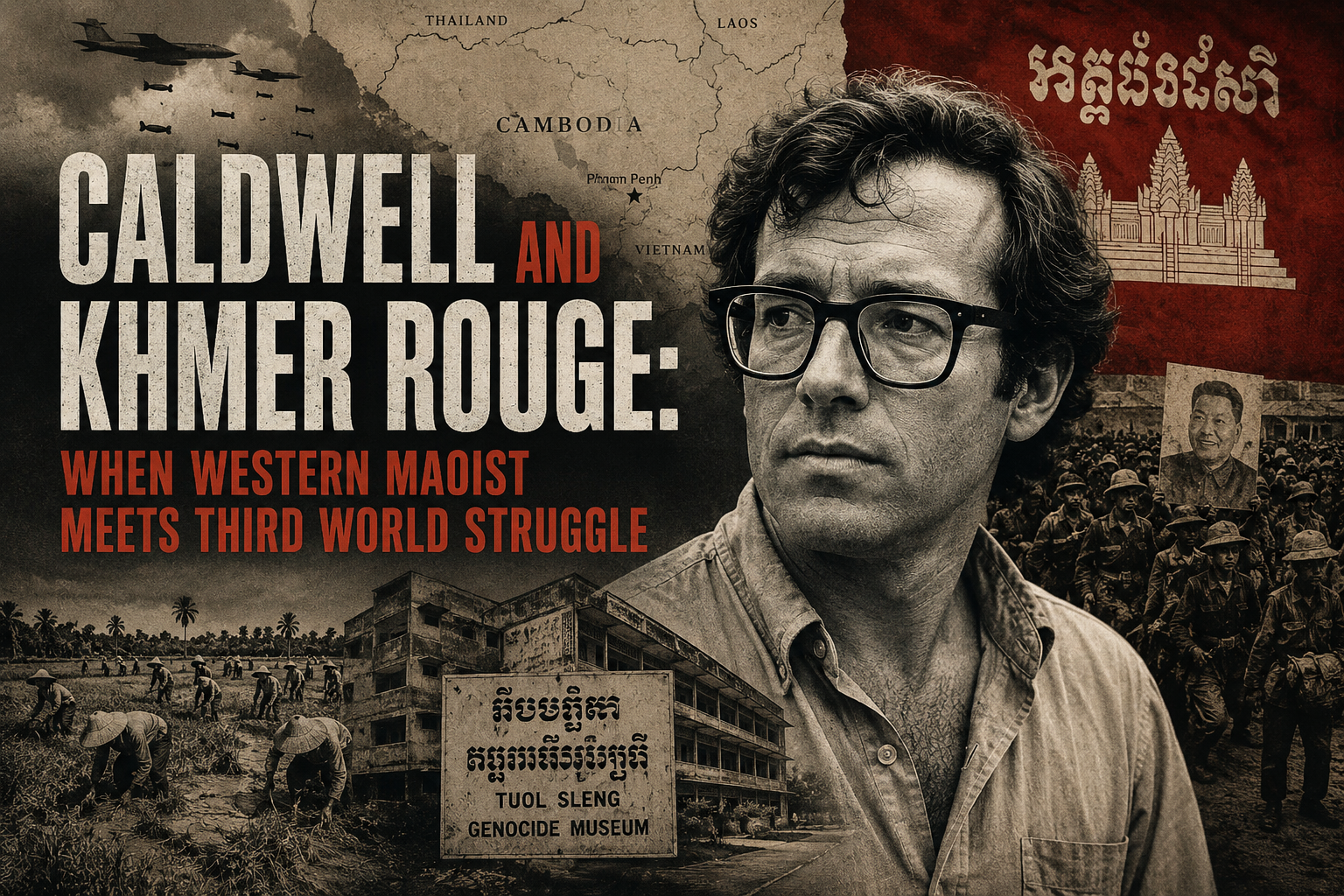
History is rarely accidental. For Malcolm Caldwell, it was the convergence of ideological conviction, geopolitical realignment, and the violent contradictions of postcolonial Southeast Asia that shaped both his intellectual trajectory and his tragic death.
Caldwell was not a romantic drifter nor a casual fellow-traveller. He was a rigorously trained scholar of Southeast Asia, political economy, and historical materialism, whose engagement with Indochina was grounded in a lifetime of anti-imperialist scholarship and praxis.
He approached the Indochinese peninsula not as a neutral observer but as a partisan of Third World emancipation, convinced that the peasantry rather than the urban proletariat constituted the decisive revolutionary subject in societies deformed by centuries of colonial extraction, imperial war, and dependency on external capital.
In his analysis, the structural relations of production, land tenure, village cooperation, labor mobilization, and subsistence agriculture formed the material preconditions of revolutionary possibility; violence, coercion, and the mobilization of surplus were not moral anomalies but historically intelligible instruments of structural transformation.
Cambodia Under Democratic Kampuchea
Between 1975 and 1979, Phnom Penh was governed by Democratic Kampuchea, a revolutionary state whose de facto authority was recognised by the People’s Republic of China and, tacitly, by the United Nations General Assembly, even as Western governments denounced it rhetorically.
This recognition reflected not moral endorsement but the alignment of geopolitical forces produced by the Sino-Soviet split and the broader Cold War, in which Cambodia was simultaneously a buffer, a pawn, and a laboratory of revolutionary experimentation.
To Western liberal commentators, Cambodia appeared as an irrational abyss, an Orientalist tableau of barbarism and cruelty. To Caldwell, however, Cambodia represented a historically intelligible attempt to reconstruct a shattered agrarian society on collectivist foundations after decades of colonial neglect, civil war, and imperial annihilation.
That annihilation was not metaphorical.
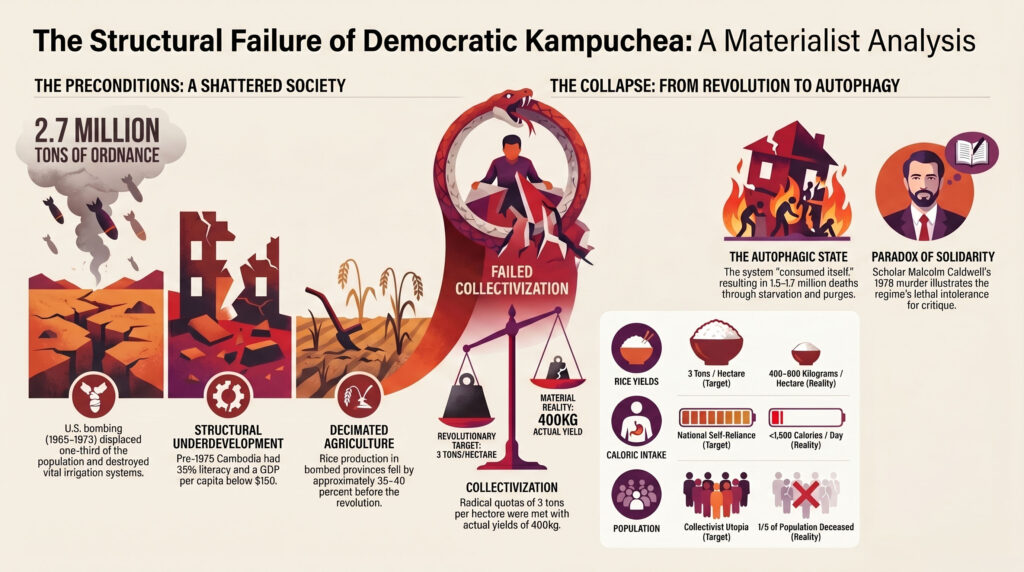
Between 1965 and 1973, the United States dropped more than 2.7 million tons of ordnance on Cambodian territory, with the heaviest concentration occurring between 1969 and 1973 during the secret bombing campaigns authorized under Operation Menu and its successors.
Conservative estimates attribute 150,000–200,000 civilian deaths directly to the bombings, while indirect mortality through displacement, famine, and disease was substantially higher.
By 1973, over two million Cambodians — approximately one-third of the population — had been displaced, many of whom were rural laborers whose villages were directly destroyed.
Rice production fell by an estimated 35–40 percent in bombed provinces; irrigation systems were shattered, draft animals killed, and village social structures pulverized.
These were the material conditions from which the Khmer Rouge emerged victorious in April 1975.
Agrarian Revolution and Structural Contradictions
Caldwell’s sympathy for Democratic Kampuchea was grounded in these historical facts.
Cambodia was overwhelmingly peasant: over 85 percent of the population lived in rural areas; per capita GDP was below USD 150 (1970 dollars); mechanised agriculture was negligible; fertiliser use averaged under five kilograms per hectare; and literacy rates remained below 35 percent.
The urban economy of Phnom Penh, swollen artificially by U.S. aid and military expenditure under the Lon Nol regime, represented not development but distortion.
In this context, the Khmer Rouge’s assault on urban privilege, markets, and landlordism was not irrational savagery but a radical, if catastrophically flawed, attempt to resolve a structural contradiction: how to construct national autonomy and socialist accumulation without industrial capital, functioning markets, or external support.
The enmity between Democratic Kampuchea and Vietnam is often misrepresented as ethnic animus or personal pathology.
Caldwell, in contrast, situated it within the political economy of the region.
The antagonism arose from centuries of contested borders, French colonial partition, and overlapping revolutionary trajectories hardened by the Sino-Soviet split.
The Khmer Rouge, aligned with China, regarded Vietnam’s Soviet-backed model as hegemonic and potentially expansionist, while Vietnam, possessing a disciplined army and nascent industrial capacity, viewed Cambodia as strategically unstable and politically dangerous.
Border skirmishes along Svay Rieng, Prey Veng, and the Mekong delta in 1977–78, which caused thousands of casualties, were not random; they reflected incompatible revolutionary projects under material and geopolitical constraints.
Collapse of the Revolutionary Project
By 1978, Democratic Kampuchea had entered a terminal phase.
Radical agrarian socialism, initially conceived as a corrective to structural underdevelopment, had metastasized into paranoid authoritarianism.
Total collectivization of land proceeded without sufficient irrigation repair, seed stock, draft animals, or technical expertise.
Household plots averaging 0.5–1 hectare were absorbed into collective brigades of 100–200 workers, tasked with quotas of up to three tons per hectare despite ecological constraints and depleted labor reserves.
Field reports from Takeo, Kampong Thom, Battambang, and Kampong Chhnang indicate actual yields between 400–600 kilograms per hectare, barely sufficient to sustain subsistence, let alone surplus extraction for industrial development.
In these brigades, forced labor, chronic malnutrition, and disease were ubiquitous; caloric intake in some regions fell below 1,400–1,500 calories per day.
Mortality from starvation, disease, and exhaustion was compounded by the security apparatus’s purges.
Between 1975 and 1979, approximately 1.5–1.7 million people — roughly one-fifth of the population — died as a consequence of these convergent pressures.
The S-21 prison alone documented over 14,000 executions, most of them former cadres suspected of deviation.
The revolution had ceased to consume only surplus; it consumed its functionaries, administrators, and intellectual allies.
Malcolm Caldwell’s Final Visit
Into this collapsing system came Malcolm Caldwell in December 1978, accompanied by Elizabeth Becker and Richard Dudman, among the last Western intellectuals permitted entry into Cambodia.
The visit was orchestrated by Ieng Sary as a final attempt to demonstrate international legitimacy and present model cooperatives and functioning brigades to foreign observers.
Yet Caldwell did not act as a passive propagandist.
He interrogated production figures, inquired into the fate of purged cadres, and questioned the logic of continuous mobilization in the absence of material means to sustain it.
In a regime that had equated critique with treason, even sympathetic questioning assumed lethal significance.
Caldwell’s murder, shortly after a private meeting with Pol Pot, was not an anomaly but the logical endpoint of a revolutionary structure that had internalized paranoia and self-preservation as its guiding logic.
Whether the killing was sanctioned by Khmer Rouge security, carried out by a rogue faction, or facilitated by Vietnamese operatives remains debated.
The structural impossibility of tolerance for critique by late 1978, however, renders the act historically intelligible.
The revolution had become autophagic.
Caldwell’s Marxist Framework
Caldwell’s Marxist methodology emphasized structural and material analysis over moral judgment.
In Problems of Socialism in Southeast Asia (1971), he argued that rural peasantries, shaped by centuries of extraction, taxation, forced labor, and colonial disruption, possessed latent anti-capitalist consciousness.
Unlike the urban proletariat, integrated into imperial and capitalist circuits through wage labor, the peasantry was relatively autonomous, organized through kinship and communal cooperation, and capable of mobilizing collectively under revolutionary leadership.
This theoretical framework informed Caldwell’s admiration for Maoist China, North Korea’s Juche system, and Vietnamese revolutionary praxis.
He engaged empirically, observing irrigation systems, cooperative rice yields, and labor organization.
He did not deny violence; he sought to understand it historically, situating executions, famine, and displacement within the longue durée of imperialism, war, and agrarian underdevelopment.
Western critics accused him of ideological blindness.
Caldwell’s position, however, was not apologetic; it was materialist.
He refused to isolate Third World revolutionary violence from imperial causality.
He argued that narratives emerging from 1978–79, particularly those framing Cambodia as a site of unmediated genocide, were instrumentalized by Vietnam to justify invasion and install a compliant regime.
He emphasized that peasant collectivization, despite enormous human cost, represented an attempt to resolve structural dependency, emancipate labor from exploitative market relations, and create conditions for national self-reliance.
The revolution’s failures were not evidence of inherent cultural pathology but of the collision between historical necessity and material insufficiency.
The Tragic Dialectic of Revolution
Caldwell’s death exemplifies the tragic dialectic of revolutionary engagement in the Third World.
It illuminates how anti-imperialist commitment collides with material and structural constraints.
It demonstrates how a state apparatus, once small and radical, expands coercion in response to scarcity, external threat, and internal uncertainty, consuming both cadre and ally.
It exposes the limits of intellectual solidarity when revolutionary mechanisms become self-protective, militarized, and paranoid.
Yet it also highlights the global context within which peripheral societies operate: the choice between dependence on imperial capital and structural self-destruction.
Caldwell’s life and death cannot be understood outside this framework.
His commitment to empirical observation, historical-materialist analysis, and comparative revolutionary study positions him neither as saint nor fool, but as an intellectual whose work insisted that the Third World be read through its own structures, constraints, and history.
Legacy and Historical Memory
Caldwell’s writings, particularly Cambodia: A Rationale for a Rural Policy (1979), insist upon structural explanation.
He foregrounded class relations, agrarian underdevelopment, and imperial entanglement as the determinative factors shaping revolutionary outcomes.
The Khmer Rouge’s excesses were horrific, yet historically intelligible.
Skulls in the countryside, famine, and coerced labor were not abstract cruelty but material consequences of attempts to restructure society under conditions of siege and ecological collapse.
His analysis reveals that revolutionary failure in Cambodia was not exceptional but emblematic of the challenges facing postcolonial societies attempting rapid social transformation in the absence of industrial bases, functioning markets, or reliable external support.
To understand Cambodia historically, Caldwell insisted, is to acknowledge both structural causality and material constraints.
Ultimately, Malcolm Caldwell’s legacy resides not in apologetics but in method, rigor, and historical fidelity.
He reminds us that revolutionary projects are judged not by moral intention alone but by their capacity to reconcile ideology with material reality.
Cambodia in the 1970s demonstrates the consequences when alignment fails: a revolution consumes its own instruments, intellectual allies, and peasant base.
Memory, too, becomes a site of struggle, contested between narratives emphasizing atrocity and those emphasizing structural explanation.
Caldwell belonged to the latter camp.
He insisted that history be read through material conditions, class relations, and the longue durée of imperial and colonial interventions.
His death, tragic though it was, exemplifies the structural imperatives and contradictions of revolutionary engagement in the Third World.
It is both a warning and a lesson: anti-imperialist commitment must be paired with structural analysis, or it risks becoming its own casualty.
 The writer is a graduate student from USM’s School of Social Science, interested in Comparative Politics, Historical Political Economy, and Chinese Politics. Prior to pursuing his undergraduate studies, he worked as a contributing researcher at political institutes and obtained a Bachelor of Social Science (Hons) in Political Science and Philosophy from Universiti Sains Malaysia.